
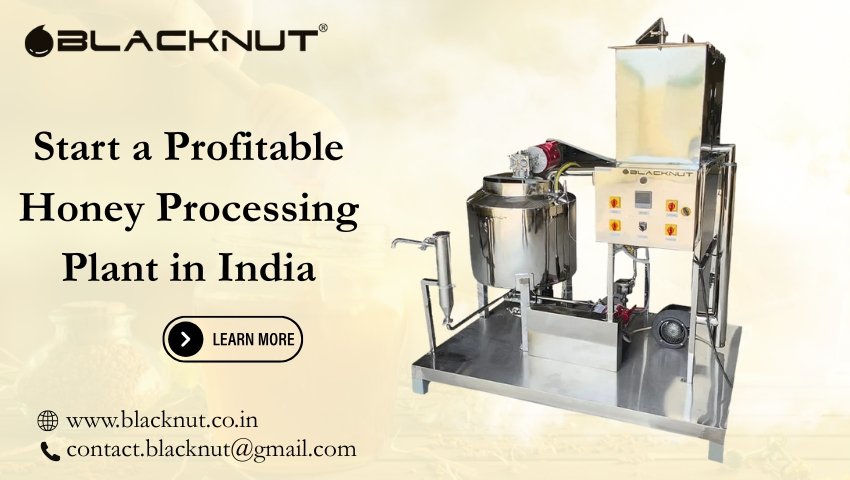
Honey Processing Plant in India: Setup & Benefits Explained
In India’s thriving honey market, entrepreneurs, co-operatives, and beekeepers increasingly recognise the value-addition possible by installing a dedicated honey processing machine (or even a small honey processing plant in India). At the same time, the brand Blacknut Agrifood Machinery Pvt Ltd offers professional-grade solutions that let you move beyond basic raw honey sales into high-quality, packaged honey ready for retail or export.
Why invest in a honey processing plant?
The market for processed honey is growing — and it’s not just about selling raw honey extracted from hives. A well-designed honey processing plant enables you to filter out impurities, reduce moisture content to safe levels, preserve aroma and flavour, and package the product for premium buyers. According to a guide for the Indian honey processing industry, the process “removes impurities like wax, debris, and moisture while preserving the natural taste and nutrients”.
Beyond quality improvements, installing a processing line creates scalability, higher margins, and potential for exports. The guidance emphasises that processed honey is “hygienic and safe to consume… ready for sale in retail, wholesale, or export markets”.
In particular in India, where beekeeping is seen as a burgeoning agribusiness with government support, a proper plant places you ahead of many small-scale competitors.
Why choose Blacknut Agrifood Machinery?
Founded in 2017 and based in Ambala, Haryana, Blacknut Agrifood Machinery Pvt Ltd is a manufacturer of agri-food processing machinery, including plants for fruit, vegetable and speciality crops.
Their catalogue lists a honey processing as one of their solutions.
Some key reasons to consider them:
Proven Indian manufacturing base with experience in food-grade machines (stainless steel, custom models)
Local support, supply chain and servicing in India (important when installing a processing plant)
Ability to integrate end-to-end lines (from raw honey intake to finished packing)
Tailoring options: capacity, automation, materials as needed
Thus, if you are seeking to set up a commercial honey processing facility in India, Blacknut is a credible partner.
What does a honey processing machine/plant do?
Let’s briefly walk through what a typical honey processing machine or plant delivers, so you appreciate how the investment converts raw material into a market-ready product.
Raw Honey Intake & Pre-Cleaning
The honey as harvested from hives contains comb wax, bee parts, bee escape, pollen, and other debris. According to technical guidance, harvesting begins with supers containing capped honey, then extraction, followed by filtration through cloth or mesh.
Heating / Liquefaction
If honey has crystallised or is too viscous, gentle heating may be applied to liquefy it without harming flavour. Some machines include jackets or hot-water systems for this purpose. For example, one Indian machine manufacturer describes their plant as including pre-heating, filtration and moisture-reduction under vacuum.
Filtration and Wax/Impurity Removal
Filtering the honey helps remove wax cappings, tiny bees, and other particulate impurities. According to the “Post-Harvest Handling Protocol for Honey,” filtration is a core step.
Moisture Reduction
A key quality and shelf-life issue for honey is moisture content. If moisture is too high the risk of fermentation increases. The protocol states “moisture reduction” is part of the processing steps.
One supplier describes a plant that reduces moisture by up to ~17% in the process.
Storage & Homogenisation
After processing, honey is stored in stainless steel tanks or drums, ensuring hygiene, preventing contamination or moisture ingress, and allowing homogenisation (i.e., uniform colour and texture).
Packing & Labelling
Finally, the processed honey is filled into jars or bottles, sealed and labelled. Although the primary focus here is the processing machine, many plants integrate or allow integration with filling and capping machines to deliver a full line.
When you choose a specialist honey processing machine, you are essentially buying equipment that handles multiple of these steps so that your end product meets food-safety, export and retail standards.
Why is capacity and design important for Indian customers?
India’s honey processing business has significant scale potential but also constraints: variable raw honey supply (seasonality), need for hygienic machinery, and cost sensitivity. According to NPCS, a small to medium honey processing unit is viable and offers entry-level investment.
When selecting a plant you should consider:
Capacity: What kilos of honey per hour or per batch you intend to process? Some Indian plants list 50 kg batches up to 2,000 kg per 8 hours.
Material: Use food-grade stainless steel (304) for parts in contact with honey to ensure durability and hygienic operations. Many Indian manufacturers emphasise this.
Moisture-control and filtration: does the machine include moisture-reduction or vacuum systems? These directly impact quality and shelf life.
Layout and automation: Ease of operation, cleaning, maintenance. With labour costs rising and hygiene demand increasing, simpler yet robust machines are preferred.
After-sales support, spare parts availability and lead-time: Domestic manufacture like Blacknut helps reduce lead time and improve service.
Commercial benefits for your business
By installing a purpose-built honey processing plant from Blacknut, you position your business to gain the following advantages:
Better margins: Processed, packaged honey commands higher prices than raw bulk honey.
Branding opportunities: With a processing line you can start under your brand, ensure consistent quality, provide transparency to buyers and retailers.
Export potential: With proper moisture control and filtration you can meet stricter export standards.
Efficiency and hygiene: Automated or semi-automated lines reduce manual contamination risk and enhance throughput.
Scalability: Starting with moderate capacity (say 100-200 kg per batch) you can scale up as business grows.
Why India is ripe for investment in honey processing
Several macro-factors make this the right time to invest:
Rising health consciousness among Indian consumers and global markets means natural sweeteners like honey are in demand.
- Government support for beekeeping and honey business in India is increasing, making the ecosystem friendlier.
- India's raw honey supply and beekeeping infrastructure are improving, offering viable input for processing plants.
- Domestic brands can differentiate through quality, traceability, and packaging — processed honey gives you that capability.
Why Blacknut is the partner you want
When you decide to invest in a honey processing plant in India, you want a partner who understands Indian market conditions, food-grade requirements, customisation, and service. Blacknut Agrifood Machinery checks those boxes:
Based in Haryana, India, with local address and manufacturing setup.
Product range includes honey plants among other agri-food machinery, indicating experience beyond one niche.
They cater for domestic supply and customisation (food-grade materials, custom capacities).
When you choose a domestic partner, lead-times and logistics are easier; spare parts and support are quicker.
Transform your honey business with advanced machinery
If you are serious about turning raw honey into market-ready, high-value product, now is the time to consider a specialised honey processing machine or full honey processing plant. Choosing a trusted Indian manufacturer like Blacknut Agrifood Machinery Pvt Ltd will help you bridge the gap between raw commodity and consumer-branded product. Good quality machinery, combined with correct processing steps (filtration, moisture reduction, hygienic storage, packing) will let you build a competitive business and scale as demand grows.
Let us help you take the next step: evaluate your required capacity, location, budget and desired output (retail jars, export drums or bulk), and contact Blacknut to explore specifications, customisations and installation timeline. With the right investment you can transform the honey business into a well-structured, profitable enterprise.