
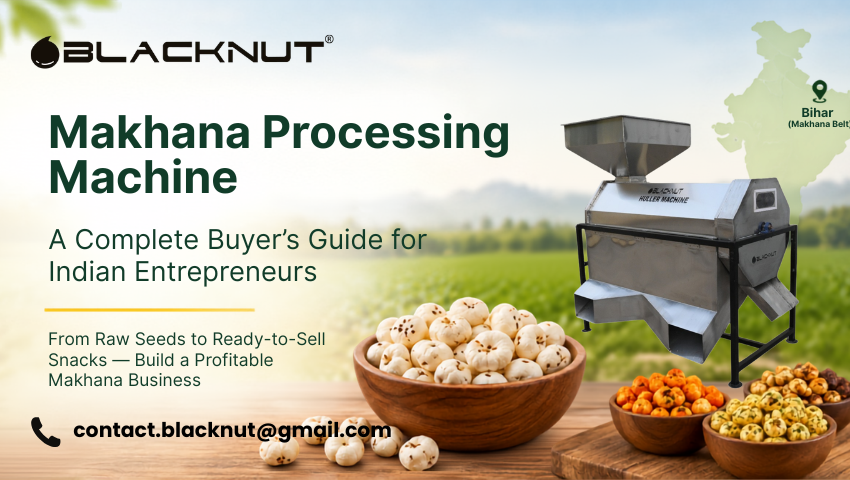
Makhana Processing Machine: A Complete Buyer's Guide for Indian Entrepreneurs
If you've ever tasted roasted makhana and thought, "there's real money in this business," you're not wrong. Makhana has quietly grown from a regional snack into a superfood that's flying off shelves across India and abroad. But here's the catch — turning raw seeds into that crunchy, market-ready product isn't something you can do by hand and still expect to compete. That's where a good makhana processing machine comes into the picture.
Whether you're a farmer in Bihar looking to add value to your harvest, a small entrepreneur planning your first unit, or an exporter scaling up operations, this guide walks you through everything — machine types, pricing, where to buy, and what to actually look for before you spend your hard-earned money.
Best Makhana Processing Machine Manufacturers in India
There's no shortage of vendors claiming to sell the "best" equipment, but only a handful actually build machines that survive daily commercial use. A genuine manufacturer will have their own factory, offer after-sales support, and — most importantly — understand the actual makhana crop, not just generic food processing.
Blacknut Agrifood Machinery is one such name that's been working specifically on makhana mechanization for over two decades. They've built machines by working directly with farmers, cooperatives, and self-help groups in Bihar, which means their equipment is designed around real problems — not just lab conditions. When you're comparing manufacturers, ask them how many years they've spent on makhana specifically, not food processing in general. It makes a difference.
What Types of Machines Are Used for Makhana Processing?
A complete makhana processing plant isn't one single machine — it's a chain of equipment, each handling a specific stage:
- Cleaning machines – remove mud, husk, and stones from raw seeds before anything else happens.
- Popping and roasting machines – the heart of the operation, where seeds are heated and popped into the familiar puffed texture.
- Grading machines – sort popped makhana by size into categories like Lava, Murra, and Thumri, since each grade fetches a different price.
- Polishing units – smoothen the rough exterior so the final product looks premium and appealing.
- Flavoring machines – coat the makhana with masala, cheese, chocolate, or caramel for the retail snack market.
- Packaging machines – vacuum or nitrogen-flushed packing to keep the product fresh for longer shelf life.
You don't necessarily need all of these on day one. Many small businesses start with just a makhana seed processing machine for popping and grading, then add flavoring and packaging as demand grows.
Affordable Makhana Processing Machines with Warranty
A common worry people have is getting stuck with a machine that breaks down in six months and no one picks up the phone. Fair concern. When you're shopping around, don't just compare the sticker price — compare what's actually included in it.
Look for suppliers who offer:
- A written warranty period (usually 6 months to 1 year on motors and core components)
- Spare parts availability without long waiting times
- Installation and operator training included in the price
- Clear documentation on power consumption and maintenance schedule
An affordable machine that comes with zero support is often more expensive in the long run than a slightly pricier one backed by a real warranty. Ask before you pay, not after something breaks.
Where Can I Buy Makhana Processing Machines in India?
You've got a few routes here. Local markets in Bihar (especially around Darbhanga, Madhubani, and Purnia — the makhana belt) have small workshops selling basic units. These can work for very small setups, but quality control varies a lot.
For anything commercial-scale, it's usually better to buy directly from an established manufacturer with a proper factory setup — companies like Blacknut, based out of Haryana, ship machines across India and also work with exporters. Buying directly from the manufacturer usually means better pricing (no middleman markup), proper documentation, and someone accountable if things go wrong post-installation.
How to Choose a Reliable Makhana Processing Machine Supplier
This is probably the most important decision in this whole process, so don't rush it. A few things worth checking:
- Ask for a factory visit or video walkthrough – if a supplier hesitates to show you where the machines are made, that's a red flag.
- Talk to existing customers – a genuine supplier will happily connect you with someone already running their machine.
- Check if they offer customization – your production capacity, space, and budget are unique to you; a good supplier adjusts the plant layout accordingly instead of forcing a one-size-fits-all setup.
- Confirm after-sales service – find out how quickly they respond if a machine part fails.
- Compare automation levels honestly – don't overspend on a fully automatic plant if you're just starting out with limited volume.
Reliable suppliers usually specialize — they'll be makhana-focused rather than trying to sell you fifteen unrelated food processing machines with makhana just tacked on.
What Is the Average Cost of a Small-Scale Makhana Popping Machine?
This is probably the question everyone actually wants answered, so let's get specific. A small-scale setup — good for entrepreneurs and SHGs starting out — usually falls in the range of ₹8 to 10 lakh. This typically covers a basic popping and grading unit, sometimes with a simple cleaning attachment.
If you're looking at a small makhana processing machine price in India that goes beyond just popping — say, including roasting, grading, and basic packing — expect the number to move up toward ₹12–15 lakh depending on capacity and how much of the process is automated.
For a fully automatic makhana processing machine built for larger volumes and export-grade output, pricing can climb to ₹25–30 lakh or more, since these plants integrate cleaning, popping, grading, polishing, flavoring, and packaging into one continuous line.
The exact makhana processing machine price in India really depends on three things: how much you want to process per hour, how much of it should run without manual intervention, and which additional machines (flavoring, vacuum packing, etc.) you include.
Top-Rated Automatic Makhana Processing Machines for Small Scale Industries
For small industries, "automatic" doesn't have to mean the giant export-scale setups. There's a growing category of compact automatic machines designed specifically for units that process a few hundred kilograms a day rather than tonnes.
These smaller automatic lines typically include:
- A semi or fully automatic popping unit with digital temperature control
- Multi-tier grading sieves for consistent sorting
- Compact polishing drums
- Optional small-batch flavoring attachments
The advantage here is you get consistency and reduced labor dependency without the massive upfront investment of a full export plant. It's a solid middle ground for anyone who's outgrown manual processing but isn't ready to run a factory-scale operation just yet.
Suppliers of Fully Automatic Makhana Processing Plants
If you're aiming for the export market or supplying institutional buyers like hotels and airlines, a fully automatic plant is where you'll eventually land. These setups run the entire chain — cleaning, roasting, popping, grading, polishing, flavoring, and packaging — with minimal manual handling at each stage.
Manufacturers offering these full plants, such as Blacknut, generally design them with stainless steel, food-grade components and built-in dust collection systems since hygiene compliance is non-negotiable for export documentation. When evaluating suppliers for a fully automatic plant, ask specifically about their export client base — a manufacturer that's already helped businesses meet international quality standards will save you a lot of trial and error.
Where to Buy Makhana Processing Machines with After-Sales Service
After-sales service is where a lot of buyers get burned, so it deserves its own mention. Before finalizing any purchase, get clarity in writing on:
- Installation support — will their team set up the machine at your site, or are you on your own?
- Operator training — do they train your staff to run the machine properly?
- Spare parts — how fast can you get a replacement part if something wears out?
- Service response time — is there a dedicated number you can call, and how quickly do they respond?
Established manufacturers with a proper factory and dealer network — again, companies like Blacknut fall into this category — tend to be more dependable here simply because they have the infrastructure to back it up, unlike smaller local fabricators who might disappear after the sale.
Features to Look for in a Good Makhana Roasting Machine
The roasting stage genuinely makes or breaks your final product's taste and shelf life, so it's worth paying close attention to the machine you pick. A good makhana roasting machine should have:
- Precise temperature control – uneven heat leads to burnt or under-roasted batches, which directly hurts your yield.
- Uniform heat distribution – rotating drums or conveyor-style roasting ensures every seed gets roasted evenly, not just the ones near the heat source.
- Energy efficiency – roasting runs for hours daily, so a machine that consumes less power adds up to real savings over a year.
- Easy cleaning access – food-grade hygiene standards mean you need to clean the drum regularly without a two-hour teardown process.
- Low noise operation – matters more than people expect, especially in smaller facilities or residential areas.
- Compatibility with flavoring units – if you plan to sell flavored makhana, check whether the roasting machine can integrate directly with a flavoring attachment.
Final Word
The makhana business has genuine potential right now, but the machines you invest in will decide whether you're running a smooth, profitable operation or constantly firefighting breakdowns and inconsistent output. Take your time comparing manufacturers, ask the uncomfortable questions about warranty and service, and match the automation level to your actual production needs — not just what looks impressive on paper.
Whether you're setting up a small unit in Bihar or planning a full export-grade facility, the right makhana processing machine manufacturers will treat this as a partnership, not just a one-time sale.
Frequently Asked Questions
Q1. How is makhana processed?
Makhana processing starts with harvesting the seeds from ponds, followed by sun-drying to reduce moisture. The dried seeds are then roasted at high heat, which causes a thermal shock — this bursts the hard black shell and turns the starch inside into the familiar light, white, puffed kernel. The popped seeds are then graded, polished, and packed based on size and quality.
Q2. What is the cost of 1 kg makhana in Bihar?
Prices typically range from ₹500 to ₹1,400 per kg, depending on the grade and whether you're buying raw seeds, wholesale lots, or retail packaged makhana. Domestic prices generally fall between ₹600 and ₹1,500 per kg depending on grade, so ₹500–1,400 is a reasonably accurate working range for Bihar specifically.
Q3. Is makhana farming profitable?
Yes, quite profitable compared to traditional crops. Net returns can reach up to ₹2.35 lakh per hectare, and profit margins are notably higher than rice or wheat farming. The real money, though, comes from processing and branding — raw seeds fetch far less than roasted, graded, and packaged makhana.
Q4. What GST applies to makhana processing machinery?
Food processing machinery in India currently attracts 18% GST. It's worth checking with your supplier whether their quoted price includes GST or not, since this is a common point of confusion during purchase.
Q5. Which plant does makhana come from — is it a lotus seed?
Makhana refers to the popped edible seeds of the prickly water lily, botanically known as Euryale ferox — the gorgon nut plant. Despite the common misconception, it does not come from the standard lotus plant.
Q6. Which region produces the most makhana in India?
Over 90% of global makhana production happens in the Mithilanchal region of Bihar, with India overall accounting for roughly 80–85% of world makhana production.
Q7. How much moisture should roasted makhana have for a crispy texture?
Moisture content should stay under 5% for that ideal brittle, crunchy texture. Anything higher and the makhana turns chewy or soft instead of crisp.
Q8. What is the export price of makhana internationally?
Export prices for premium-grade makhana range roughly between $15.50 to $20.00 USD per kg, with strong demand coming from the USA, Canada, and the UAE.
Q9. Is makhana good for weight loss?
Yes — it's low in fat, light on the stomach, and keeps you feeling full for longer, which is why it's become popular as a guilt-free snack alternative to fried options.
Q10. How can I start a small roasted makhana processing unit?
You'll need a decent roasting machine to begin with, proper workspace, FSSAI licensing, and a basic packaging setup. Most small units start lean and add grading, polishing, or flavoring equipment as the business grows.