
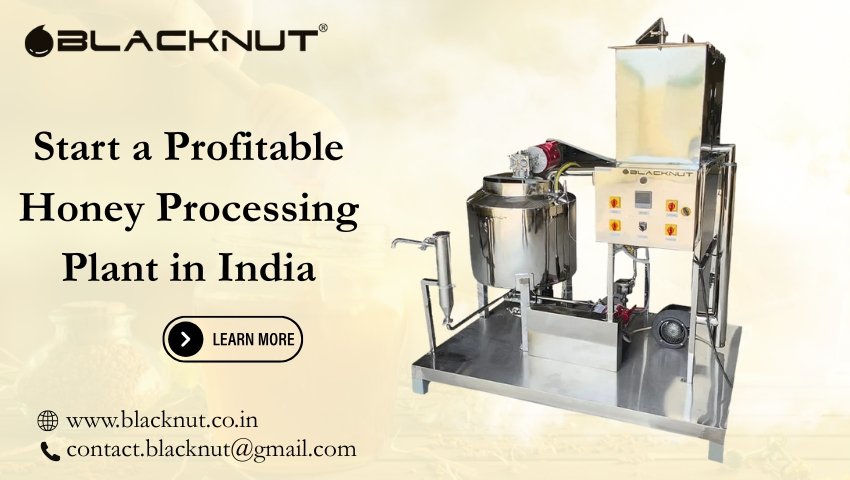
Honey Processing Plant in India: Setup, Investment & 2026 Guide | Blacknut
You are a beekeeper, an SHG, an entrepreneur, or an agri-investor.
You have access to raw honey. Or you are planning to enter the honey business.
And you want to know, how do I actually set up a honey processing plant in India?
What will it cost? What machines do I need? Is it actually profitable?
This guide answers all of that. Honestly. With real numbers.
Here is what you will find inside:
- Why honey processing is a genuine business opportunity right now
- What a honey processing plant actually does, step by step
- Real investment figures and price ranges for 2026
- Profit margins and ROI you can expect
- Licenses you need to start legally
- How Blacknut helps you set it up
Let's get into it.
Who Is This Guide For?
You are in the right place if you are:
A beekeeper or apiculturist who currently sells raw honey at commodity prices and wants to process and package it under your own brand to earn significantly more per kg.
An SHG or FPO looking to add a honey processing unit to create employment and income for members in rural areas where beekeeping is common.
An entrepreneur or investor evaluating the honey processing business as a food startup, researching investment, machines, margins, and market potential.
An exporter who wants to supply processed, filtered, export-grade honey to buyers in the US, Europe, the Middle East, or the UAE.
This guide is not for you if you are looking for honey farming or beekeeping guidance. This guide covers only the processing and machinery side of the business.
Why Honey Processing Is a Real Business Opportunity in India Right Now
Raw honey is everywhere in India.
India has an abundant raw honey supply supported by growing beekeeping infrastructure and government beekeeping development programs.
But here is the problem most beekeepers face: they sell raw honey at ₹150 to ₹300 per kg to middlemen. Meanwhile, the same honey, processed, filtered, branded, and packaged, sells at ₹400 to ₹1,200 per kg in retail.
That gap is your business opportunity.
The difference between raw honey and retail honey is not quality. It is processing.
A honey processing plant is what closes that gap.
The market is growing fast:
- Urban consumers are shifting toward natural health foods; honey demand is rising steadily
- E-commerce platforms make it easy to sell branded honey directly to consumers
- Export demand from the US, UAE, Europe, and Southeast Asia is growing every year
- Government schemes like PMFME actively support honey processing entrepreneurs with subsidies
What Does a Honey Processing Plant Actually Do?
Raw honey collected from hives looks and smells like honey. But it contains:
- Wax particles from the comb
- Pollen and bee parts
- Excess moisture, often above 20 percent
- Yeast and bacteria
All of this makes raw honey unsuitable for retail sale, export, and extended shelf life.
A honey processing machine transforms raw honey into a pure, stable, market-ready product through a series of controlled steps.
Here is exactly what happens:
Step 1: Raw Honey Intake and Melting
Raw honey collected from farms or bought from beekeepers is received in drums or containers.
If the honey has crystallized, which happens naturally, it is gently heated in a honey melting tank using a double-jacket non-contact heating system. This brings it back to a liquid state without damaging enzymes, flavor, or nutritional value.
Temperature is carefully controlled, typically 40 to 45°C, to preserve all natural properties.
Step 2: Filtration
Melted honey passes through a multi-stage filtration system.
- First stage: Coarse filter removes wax chunks, bee parts, and large debris
- Second stage: Fine filter removes pollen, dust, and microparticles
- Output: Crystal-clear honey that meets retail and export purity standards
This is the step that determines whether your honey looks premium or cloudy. Premium presentation commands premium pricing.
Step 3: Moisture Reduction (Most Critical Step)
This is the most important step in the entire process and the one most small-scale operations skip.
Natural honey from hives often has moisture content above 20 percent. At this moisture level, honey will ferment within weeks, making it unsellable.
A vacuum moisture reduction unit removes excess moisture under controlled vacuum conditions, bringing moisture content below 18 percent. At this level, honey has a shelf life of 18 to 24 months or more.
This is what makes the difference between honey that lasts and honey that spoils.
Step 4: Pasteurization
The filtered, moisture-reduced honey passes through a pasteurization unit where it is gently heated to 60 to 65°C and held for a controlled time period.
This eliminates yeast and bacteria without destroying the natural enzymes and nutritional compounds that make honey valuable.
After pasteurization, the honey is safe, stable, and ready for long-term storage.
Step 5: Cooling and Homogenization
Pasteurized honey is cooled in a controlled cooling unit to room temperature.
It then passes through a homogenizer, which ensures uniform texture, color, and consistency across the entire batch.
This is important for branding; every jar of your honey needs to look and taste identical.
Inconsistent texture is the most common customer complaint for honey brands.
Step 6: Storage
Processed honey is stored in food-grade SS304 stainless steel tanks until it is ready for filling and packaging.
Storage tanks are hygienically sealed to prevent moisture ingress and contamination during the waiting period.
Step 7: Filling and Packaging
Honey is filled into your chosen packaging format:
- Glass jars for premium retail
- PET bottles for mass market
- Sachets for portion control and HORECA
- Bulk drums for export or B2B supply
Automated or semi-automated filling machines maintain hygiene and consistency at scale.
Honey Processing Plant Investment: Price Ranges
This is what most people want to know first.
Here are honest price ranges based on current market data:
| Plant Configuration | Capacity | Approx. Price Range |
| Basic filtration and bottling unit | Up to 100 kg per batch | ₹2.5 lakh – ₹4 lakh |
| Semi-automatic with moisture reduction | 100 to 500 kg per batch | ₹4 lakh – ₹9 lakh |
| Fully automatic with pasteurization | 500 to 2000 kg per batch | ₹9 lakh – ₹18 lakh |
| Large commercial export-grade plant | 2000 kg and above | ₹18 lakh – ₹25 lakh+ |
Beyond the machine, other costs to budget:
| Cost Item | Approximate Budget |
| Premises setup and civil work | ₹1 lakh – ₹5 lakh depending on size |
| Packaging design and materials | ₹50,000 – ₹2 lakh |
| FSSAI and other licenses | ₹10,000 – ₹30,000 |
| Initial raw material (raw honey) | ₹1 lakh – ₹5 lakh |
| Working capital for first 3 months | ₹2 lakh – ₹8 lakh |
Total startup investment for a small to mid-scale honey processing unit: ₹8 lakh to ₹30 lakh depending on capacity and scale.
Can you reduce this with a government subsidy?
Yes. The PMFME Scheme (Pradhan Mantri Formalisation of Micro Food Processing Enterprises) offers up to a 35% credit-linked subsidy on food processing machinery. A honey processing plant qualifies under this scheme.
At 35% subsidy, a ₹10 lakh investment in machinery becomes an effective cost of ₹6.5 lakh.
That is a significant reduction in your capital requirement.
Contact Blacknut; we guide our clients through the PMFME application process at no extra charge.
Honey Processing Business - Profit Margins and ROI
Let's talk real numbers.
Raw material cost: Raw honey from beekeepers or mandis, ₹150 to ₹350 per kg depending on variety and region.
Processed honey selling price:
- Retail packaged honey: ₹400 to ₹600 per kg
- Premium / organic honey: ₹600 to ₹1,200 per kg
- Export bulk honey: ₹250 to ₹450 per kg (FOB pricing)
What this means: A honey processing business typically achieves 30 to 40 percent gross margins and 15 to 20 percent net profit after accounting for raw material, utility, labor, and overhead costs.
Simple profitability calculation for a medium-scale unit:
| Item | Numbers |
| Daily processing capacity | 300 kg of raw honey |
| Raw honey cost per kg | ₹250 |
| Daily raw material cost | ₹75,000 |
| Processed honey yield (90% of raw) | 270 kg |
| Selling price per kg (retail) | ₹500 |
| Daily revenue | ₹1,35,000 |
| Daily gross profit | ₹60,000 |
| Monthly gross profit (25 working days) | ₹15,00,000 |
| After all operating costs (35% net margin) | ₹5,25,000 net per month |
Break-even on a honey processing plant investment typically ranges from 2 to 4 years depending on production capacity, market demand, and operational efficiency.
Licenses You Need to Start a Honey Processing Business in India
Do not start operations without these:
1. FSSAI License (Mandatory)
- Under ₹12 lakh turnover: Basic FSSAI Registration
- ₹12 lakh to ₹20 crore: State FSSAI License
- Above ₹20 crore: Central FSSAI License
2. GST Registration
Required once annual turnover exceeds ₹20 lakh.
3. Udyam (MSME) Registration
Free to register. Required to access PMFME subsidy and other government schemes.
4. Trade License
Issued by the local municipal body. Required to operate a food processing unit.
5. For Export Only:
- IEC (Import Export Code) from DGFT
- APEDA Registration for agricultural food products
How to Choose the Right Honey Processing Plant for Your Scale
Not everyone needs the same plant. Here is a simple guide:
You are a beekeeper or small SHG with 50 to 100 hives: Start with a basic filtration and moisture reduction unit at ₹2.5 to ₹4 lakh. Focus on local retail and direct sales first. Scale up when demand grows.
You are setting up a dedicated honey processing unit for 10 to 50 beekeepers in your area: A semi-automatic plant at ₹4 to ₹9 lakh handling 200 to 500 kg per batch is the right starting point. Serves SHGs, cooperatives, and FPO models well.
You are a commercial processor targeting retail chains and exports: A fully automatic plant at ₹9 to ₹18 lakh with complete pasteurization and packaging integration is needed. Meets FSSAI and export quality standards consistently.
You are a large-scale exporter: An industrial-grade plant starting from ₹18 lakh with 2000 kg and above capacity per batch. Requires APEDA registration and export-standard packaging.
Why Blacknut for Your Honey Processing Plant in India
Blacknut Agrifood Machinery Pvt. Ltd. is based in Ambala, Haryana, and manufactures honey processing plants specifically designed for Indian entrepreneurs, not adapted from foreign industrial equipment.
Here is what you get when you choose Blacknut:
- Food-grade SS304 construction on all product contact surfaces, FSSAI compliant
- Double jacket non-contact heating technology for gentle moisture reduction
- Multiple capacity configurations from 100 kg to 2000 kg per batch
- Customisation based on your specific requirement and budget
- PMFME subsidy guidance we help you apply at no extra charge
- Installation and operator training included with every plant
- After-sales support available after the sale, not just before it
Contact Blacknut today for a free consultation and honest price quote
FAQs: Frequently Asked Questions
What is the price of a honey processing plant in India in 2026?
Honey processing plants range from ₹2.5 lakh for basic small-scale units to ₹25 lakh for large commercial export-grade plants. A mid-scale semi-automatic plant with moisture reduction typically costs ₹4 to ₹9 lakh. Contact Blacknut for an exact quote based on your capacity and feature requirements.
Is the honey processing business profitable in India?
Yes. Honey processing businesses achieve 30 to 40 percent gross margins with 15 to 20 percent net profit. Processing and branding raw honey multiplies its value; retail honey fetches 2 to 4 times the price of raw bulk honey at current market rates.
What machines are needed in a honey processing plant?
A complete honey processing plant includes a honey melting tank, filtration unit, vacuum moisture reduction unit, pasteurizer, homogenizer, storage tanks, and filling and packing machine. Individual machines can also be purchased separately based on your current stage of operation.
Is a honey processing plant eligible for the PMFME subsidy?
Yes. The PMFME Scheme offers up to a 35% credit-linked subsidy on food processing machinery. A honey processing plant qualifies. Blacknut helps clients with the complete application process at no extra cost.
What licenses are needed to start honey processing in India?
You need FSSAI registration or license, GST registration, Udyam MSME registration, and a trade license. For export, IEC and APEDA registration are additionally required.
What is the minimum investment to start a honey processing unit?
A small-scale basic unit can be started with ₹5 to ₹8 lakh total investment, including machinery, premises setup, licensing, and initial raw material. A properly scaled commercial unit needs ₹15 to ₹30 lakh.
How long does it take for a honey processing plant to pay for itself?
Break even on a honey processing machine typically ranges from 2 to 4 years depending on production capacity, market demand, and operational efficiency. Strong branding and direct-to-consumer distribution can accelerate payback significantly.
How do I start a honey processing business in India?
Start by identifying your honey source, local beekeepers, cooperatives, or your own farm. Register your business under Udyam and get FSSAI. Apply for the PMFME subsidy. Invest in the right machines based on your capacity target. Build your brand and distribution. Contact Blacknut for a complete turnkey setup consultation.
Conclusion
India has abundant raw honey. What it needs is more entrepreneurs who can turn that raw honey into premium, packaged products that command proper prices.
A honey processing plant is not just equipment. It is the bridge between a raw agricultural commodity and a branded consumer product.
Get the plant right, with proper moisture control, filtration, and food-grade construction, and you get consistent quality every batch. And consistent quality is what builds brand trust.
Ready to set up your honey processing plant in India?
Contact Blacknut today for a free consultation, honest price guidance, and a plant built specifically for Indian entrepreneurs.
Last Updated:- 05-June-2026