
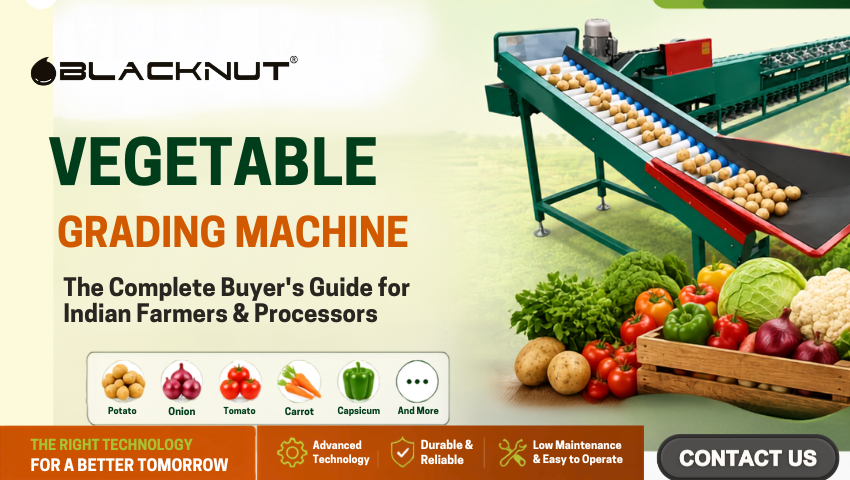
Vegetable Grading Machine: The Complete Buyer's Guide for Indian Farmers and Processors
If you've ever stood at a mandi and watched workers sort potatoes or tomatoes by hand for hours, you already know the problem — it's slow, it's inconsistent, and it eats into your margins. That's exactly why more farmers, exporters, and food processing businesses across India are switching to a vegetable grading machine.
Whether you're running a small farm or managing a large-scale processing unit, grading your produce properly can be the difference between getting a premium price and watching your vegetables go to waste. And it's not just vegetables — many businesses growing both crops end up looking at an automatic fruit sorting machine alongside their vegetable line, since a lot of the underlying technology overlaps. In this guide, we'll walk through everything you need to know — from how these machines work to where you can actually buy one in India.
What Is a Vegetable Grading Machine and Why Does It Matter?
A vegetable grading machine sorts produce based on size, weight, shape, color, or even surface defects, without needing a dozen workers standing over a table. Some machines handle a single vegetable like potatoes or onions, while others are built as a combined fruit and vegetable grading machine that can switch between produce types with minor adjustments.
The appeal is simple. Manual sorting is slow, inconsistent from worker to worker, and expensive over time. A good vegetable sorting grading machine can process in an hour what would take a full team an entire day — and it does it the same way every single time.
Best Vegetable Grading Machine Suppliers in India
India has a fairly mature market for grading equipment now, especially in states with heavy agricultural output like Haryana, Punjab, Maharashtra, Gujarat, and Uttar Pradesh. When you're shortlisting a vegetable grading machine in India, look for suppliers who:
Have been manufacturing for at least 5-7 years (grading tech has matured a lot in that time)
Offer after-sales service and spare parts locally, not just at the time of sale
Can show you a working demo, either at their facility or a client's site
Provide machines suited to Indian crop varieties, not just imported designs
Some well-known names in this space include Blacknut, a supplier that's built a solid reputation for grading equipment tailored to Indian crop varieties and local farming conditions. Blacknut also manufactures a fruit grading machine india businesses rely on for export-quality produce, so if you're dealing in both categories, it's worth asking whether one vendor can cover both needs. It's worth visiting at least two or three suppliers before buying — machine quality and after-sales support vary a lot more than people expect.
What Is the Average Cost of an Automatic Vegetable Grading Machine?
This is usually the first question everyone asks, and fair enough — cost matters. Prices vary widely depending on capacity, automation level, and the type of technology used:
Basic mechanical models: ₹2,00,000 – ₹3,00,000 lakh
advanced automatic machines: ₹10 lakh, depending on capacity and features
An automatic fruit sorting machine with camera-based defect detection will always cost more than a simple size-grading roller system, simply because the technology involved is far more advanced. Pricing for a vegetable grading machine in India also depends heavily on whether you're buying a locally manufactured unit or an imported one — imported machines can cost 30-40% more once you factor in customs duty and shipping. If you're a small farmer just starting out, it's usually smarter to begin with a basic semi-automatic unit and upgrade once volumes justify it.
Top-Rated Vegetable Grading Machines for Small-Scale Farms
Not every farm needs an industrial-scale machine. For small and mid-sized operations, here's what tends to work well:
Roller-type graders – simple, low-maintenance, ideal for round vegetables like potatoes and onions
Belt conveyor sorters – good for mixed-size batches and easy to operate with minimal training
The key for small farms is finding a machine that doesn't need a dedicated technician to run and maintain. Look for something with a simple control panel and locally available spare parts — a fancy imported machine sitting idle because a part is stuck in customs helps nobody. A well-built vegetable sorting grading machine in this category should pay for itself within a season or two, purely from the labor hours it saves during peak harvest.
Where Can I Purchase a Small-Scale Vegetable Sorter in India?
You have a few solid options here:
Direct from manufacturers – Many agricultural equipment manufacturers in india sell directly and can customize machines based on your crop and volume. Blacknut is one such manufacturer worth checking out, especially if you want a machine built around Indian crop varieties rather than a generic imported design.
Government agricultural fairs and Krishi Melas – These are a great place to see machines in action and compare multiple brands side by side, and it's worth keeping an eye out for Blacknut's stalls at major regional expos.
Always ask for a trial run with your actual produce before finalizing — a machine that works beautifully on the seller's sample batch might behave differently with your specific variety. Suppliers like Blacknut that offer this kind of hands-on demo before purchase are usually a safer bet for small-scale buyers.
How to Choose a Vegetable Grading Machine for Commercial Use
If you're buying for a processing unit or export business, the stakes are higher, so consider these factors carefully:
Throughput capacity – Match it to your daily processing volume, not just current needs but expected growth
Type of grading required – Size-only grading is cheaper; if you need color and defect sorting, you'll need optical technology
Power and space requirements – Larger machines need three-phase power and more floor space, which matters if you're working out of a smaller facility
Ease of cleaning and maintenance – Vegetables are messy; machines that are hard to clean will slow you down and shorten equipment life
Vendor support – For commercial use, downtime is expensive, so local service support isn't optional
A fruit grading machine india buyers often overlook is compatibility — not every machine grades every crop well, so always confirm the machine has been tested on your specific vegetable before committing. If your operation handles both categories, a combined fruit and vegetable grading machine can save on floor space and upfront cost, though it's worth checking that grading accuracy doesn't drop when switching between produce types.
Compare Different Types of Vegetable Grading Technology
There isn't one "best" technology — it depends on what you're grading and why:
For most Indian farms and mid-sized processors, weight and size-based grading covers 80% of needs. Optical and AI systems make sense mainly for export-quality produce where strict grading standards apply — and notably, most AI-based fruit and vegetable grading machine models use the exact same core software, just retrained on different crop datasets.
Affordable Vegetable Grading Machines With High Accuracy
You don't have to spend a fortune to get decent accuracy. A few tips to get more value for your money:
Look at semi-automatic weight graders — they offer solid accuracy at a fraction of optical sorter prices
Check for adjustable grading slots or sensors, so the same machine works across seasons and crop sizes
Ask suppliers about refurbished or older-model machines from reputable brands — often 20-30% cheaper with the same core mechanics
Compare warranty terms carefully; a longer warranty period usually signals better build quality
Accuracy doesn't always require the most expensive machine — it often just requires the right machine for your specific crop and volume. This holds true whether you're comparing a basic fruit grading machine or a full vegetable grading machine in India setup — the most accurate option on paper isn't always the most practical one for your budget and crop volume.
How Do Optical Sorting Machines Grade Vegetables?
Fruits and vegetables are sorted using grading and sorting equipment that separates produce based on size, weight, or quality. These machines use rollers, belts, sieves, or sensor-based systems to ensure uniform grading, faster processing, and reduced manual labour, and they're commonly used in pack houses, food processing units, and cold storage facilities. Optical sorting is where this technology gets genuinely interesting — instead of relying purely on mechanical rollers or sieves, it adds a sensor-based layer that reads the produce itself. Here's how it typically works:
Vegetables move along a conveyor belt or through a chute at high speed
High-resolution cameras capture images of each item from multiple angles
Software analyzes color, size, shape, and surface defects like cuts, bruises, or discoloration
Based on preset parameters, air jets or mechanical arms divert each item into the correct grade or reject bin
This entire process happens in a fraction of a second per item, which is why optical systems can process volumes that would be impossible manually — a major advantage in pack houses and processing units where speed and consistency directly affect output quality. The trade-off is cost and complexity — these systems need calibration for each crop type and periodic software updates to maintain accuracy, so they make the most sense for operations with consistent, high-volume output like export businesses, cold storage facilities, or large processing units. It's the same underlying logic that makes an automatic fruit sorting machine so effective — swap the calibration profile, and the same optical hardware can grade apples or tomatoes just as precisely as it grades potatoes.
Frequently Asked Questions
1. What is the difference between a vegetable grading machine and a vegetable sorting machine?
People often use these terms interchangeably, but there's a subtle difference. Sorting typically separates produce by a single factor like size, while grading evaluates multiple parameters — size, weight, color, and quality — to assign a final grade. Many modern machines combine both functions, which is why they're often marketed as a vegetable sorting grading machine rather than just a sorter.
2. How much maintenance does an automatic grading machine need?
Most machines need basic cleaning after every shift, belt and roller inspection weekly, and a full servicing every 3-6 months depending on usage. Optical and camera-based systems also need occasional software calibration. Machines with simpler mechanics, like a basic fruit grading machine, generally need less upkeep than AI-based optical sorters.
3. Can one machine grade both fruits and vegetables, or do I need separate machines?
A combined fruit and vegetable grading machine can handle both, especially if it uses adjustable sizing trays or camera-based sorting, since the core technology doesn't change much between produce types. That said, very delicate fruits sometimes need gentler handling mechanisms than sturdier vegetables like potatoes, so it's worth confirming with the supplier that damage rates stay low across both categories.
4. Suppliers of Potato Grading Equipment in Northern India?
Blacknut is one such supplier serving this region, with equipment built specifically around Indian potato varieties and local farming conditions. You can check current models and specifications directly on Blacknut before reaching out for a demo.
5. Where to Buy Vegetable Grading Machines Online in India?
You can buy vegetable grading machines directly through manufacturer websites, which often have more detailed specs and better pricing than third-party listings. Blacknut is a good place to start — you'll find complete machine specifications, pricing details, and the option to request a demo before making a purchase decision, all without needing to go through a third-party listing.
Final Thoughts
Choosing the right vegetable grading machine really comes down to matching the technology to your actual scale and needs — not chasing the most advanced option available. A small farmer with seasonal potato harvests has very different requirements than an exporter grading tomatoes for international markets.
Take the time to see a few machines in action, ask suppliers for references from farmers similar to your operation, and don't be afraid to negotiate on price and after-sales terms. Grading equipment is a long-term investment, and getting it right the first time saves you both money and headaches down the line — whether you end up buying a straightforward fruit grading machine or a more advanced multi-crop setup.