
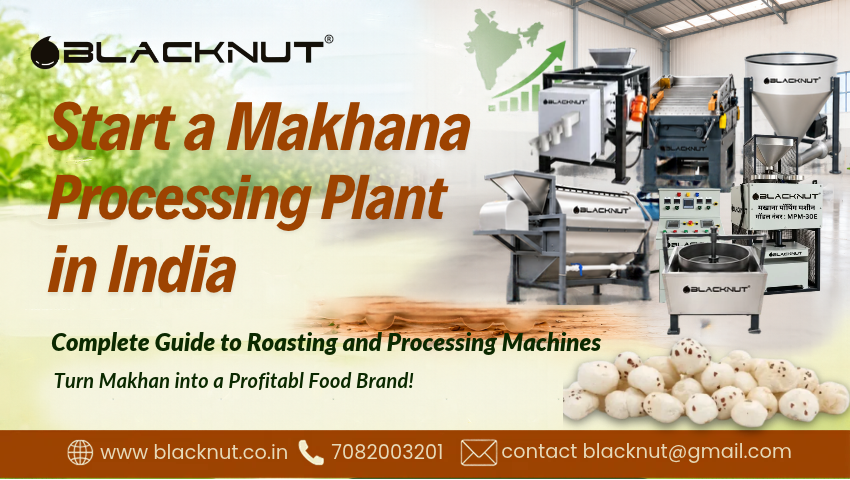
Start a Makhana Processing Plant in India : Complete Guide to Roasting and Processing Machines
Walk into any health store, airport shop or even a neighbourhood kirana today and you'll spot packets of flavoured makhana on the shelf. Peri-peri, cheese, salted, caramel. A snack our grandmothers made during fasts has quietly become a mainstream health food.
And the demand isn't slowing down. More people are looking for high-protein, low-fat, gluten-free snacks, and makhana (fox nuts) ticks every box. That's exactly why so many first-time entrepreneurs, farmers and small manufacturers are now looking at setting up a makhana processing plant.
If you're one of them, this guide is for you. We'll walk through how the process works, what machines you actually need, what to look at before buying, and how to avoid the mistakes that cost new business owners money.
India is the biggest producer of makhana, and most of it is grown in Bihar. Yet a large share still leaves the farm as raw seed. A well-planned makhana processing plant in India lets you keep that value at home: you buy seed, process it, and sell clean, popped and packed makhana under your own name. A small makhana plant today can easily grow into a proper food brand tomorrow.
Why Is Makhana Such a Good Business Right Now?
A few simple reasons:
Growing health-food demand - Makhana is light, protein-rich and low in fat, which is exactly what snack buyers want today.
Value addition pays - Selling raw seeds earns far less than selling cleaned, popped and packed makhana. Processing is where the margin sits.
Export potential - Indian makhana is increasingly in demand in international markets.
Government attention - Makhana, especially from Bihar's Mithila region, has been getting more policy and market support in recent years.
The catch? Traditional makhana processing is slow, labour-heavy and inconsistent. A skilled worker roasting seeds over a fire can only do so much in a day, and quality changes from batch to batch. That's where machines change the game.
Makhana Benefits and Protein: What Your Customers Are Actually Buying
To sell makhana well, it helps to know why people pick it up in the first place. These are the makhana benefits buyers talk about most:
Light and low in fat - It feels like a snack, not a guilt trip.
Gluten-free - Easy for people with dietary restrictions to say yes to.
Good plant-based nutrition - Makhana protein is a big selling point. Popped makhana has roughly 9 to 10 g of protein per 100 g (approximate; values vary by source), along with fibre and minerals like magnesium and potassium.
Fasting-friendly - It has been part of varat and festival food for generations.
This matters for your business because every one of these points can go on your packaging, your website and your product listings. Customers don't buy a machine's output. They buy the benefit.
Makhana Board and Government Support
The Makhana Board, announced in the Union Budget 2025 for Bihar, is meant to support farmers and entrepreneurs with better production, processing, value addition and marketing. For anyone planning a processing unit, that is a good sign. Policy attention usually brings better training, easier market access and more confidence among buyers and lenders. Keep an eye on current announcements and scheme details from official sources before you apply for any support.
How Makhana Is Processed: The Basic Steps
Before you buy anything, it helps to understand what actually happens to the seed. Here's the usual flow in a processing unit:
Cleaning and grading - Raw fox nut seeds (gurri) are cleaned to remove mud, husk bits and debris, then graded by size. Size matters because uniform seeds pop uniformly.
Drying and conditioning - Seeds need the right moisture level before roasting. Too wet or too dry, and you'll get poor popping.
Roasting - Seeds are heated so the hard black shell becomes brittle and the kernel is ready to expand.
Shell breaking and popping - The roasted seed is struck or pressed, and the white, fluffy makhana pops out.
Polishing and sorting - Popped makhana is cleaned, polished and sorted by size and quality.
Packing - Finished makhana is packed in airtight, moisture-proof packaging, either plain or after flavouring.
Only a small share of the raw seed weight ends up as finished popped makhana (roughly 40% in many cases, depending on seed quality and process). So efficiency at every step directly affects your profit.
In simple terms, good makhana processing is all about small details done consistently: clean seeds, even sizes, the right moisture, steady heat and careful handling after popping. Get these right and your pop rate, colour and crunch all improve together.
Machines You Need in a Makhana Processing Plant
A good makhana processing plant brings several machines together so the whole flow runs smoothly. Here's what to look for.
1. Seed Cleaning and Grading Machine
Removes dust, stones and waste, and separates seeds by size. Skipping this step is a false economy. Dirty or mixed-size seeds lead to uneven roasting and lower yield.
2. Makhana Roasting Machine
This is the heart of the plant. A good makhana roasting and flavouring machine gives you even heat, controlled temperature and consistent batches. Manual roasting over a fire depends heavily on the worker's skill and stamina, while a machine gives you repeatable results, day after day.
When comparing roasting machines, check:
Heating method and temperature control
Capacity per hour
Build quality and material (food-grade parts matter)
Ease of cleaning and maintenance
Energy and fuel consumption
You may also hear this machine called a makhana roaster machine, and the thing to remember is that the name matters less than the performance. Ask for a demo with your own seeds if you can. The quality of the makhana roasted in that machine, meaning how evenly the seeds heat and how well they pop, tells you more than any brochure.
3. Makhana Popping
A reliable makhana processing machine handles shell breaking and popping with less manual effort and fewer broken pieces. Higher pop rate and fewer broken kernels mean more sellable product from the same quantity of seeds.
Some buyers search for this equipment as a makhana popping plant, while others call the whole line a makhana making machine. They usually mean the same thing: the machinery that turns raw seeds into ready-to-pack popped makhana. When you compare suppliers, ask exactly which steps each machine covers so you can compare like with like.
Looking for a Reliable Makhana Popping Plant?
Explore BLACKNUT's Makhana Popping Plant, compare 3 available models, and find the right solution for your processing requirements.
4. Polishing and Sorting Equipment
This gives your makhana a clean, bright look and removes broken or discoloured pieces. Presentation counts, especially if you're selling to retailers or brands.
5. Packaging Machine
Makhana absorbs moisture quickly and loses its crunch. Proper sealing and packaging protect shelf life and quality.
If you'd rather not source each machine separately, a complete setup can save you a lot of coordination headaches. You can see a ready option here: makhana processing plant.
Makhana processing plant की मशीनरी और पूरा सेटअप कैसे काम करता है?
अगर आप पहली बार makhana processing plant लगाने की सोच रहे हैं, तो सबसे पहले ये समझ लीजिए कि पूरा सेटअप एक चेन की तरह काम करता है। एक मशीन का आउटपुट सीधे अगली मशीन का इनपुट बनता है।
कच्चा बीज (गुर्री) सबसे पहले क्लीनिंग और ग्रेडिंग मशीन में जाता है, जहाँ मिट्टी, कचरा और छोटे-बड़े दाने अलग हो जाते हैं। इसके बाद बीज को सही नमी तक लाया जाता है, फिर रोस्टिंग मशीन में गर्म किया जाता है ताकि ऊपर का सख्त छिलका कमज़ोर हो जाए। अगला स्टेप पॉपिंग का है, जहाँ छिलका टूटता है और सफ़ेद फूला हुआ मखाना बाहर आता है। आख़िर में पॉलिशिंग, सॉर्टिंग और पैकिंग होती है।
प्लांट की जगह बनाते समय एक बात का ध्यान रखें: कच्चे माल का स्टोर, प्रोसेसिंग एरिया, पैकिंग एरिया और तैयार माल का गोदाम, ये चारों अलग और सूखे रहें। मखाना नमी बहुत जल्दी पकड़ लेता है, और नमी आते ही उसका कुरकुरापन चला जाता है।
छोटे सेटअप में कई काम हाथ से भी हो सकते हैं, जबकि बड़े प्लांट में पूरी लाइन लगभग कनेक्टेड रहती है। आप कौन सा रास्ता चुनें, ये आपके कच्चे माल की सप्लाई और बिक्री की प्लानिंग पर निर्भर करता है।
Ready to Set Up Your Own Makhana Processing Plant?
Looking for the right machinery for your makhana processing business?Explore BLACKNUT's advanced processing solutions and find the right machines for your plant requirements.
Get Machine Details & Enquire Now →Cost of setting up a small makhana processing unit in India
Most people want a single number, but the honest answer is that the cost of setting up a small makhana processing unit in India depends on how small "small" is. A unit that only roasts and pops will cost far less than one that also grades, polishes and packs.
Here's what usually goes into the budget:
Machinery (the biggest chunk, and it varies with capacity and automation)
Shed or rented space, with proper flooring and ventilation
Electricity connection and installation
Licences and registrations (FSSAI, GST and local approvals)
Raw material stock, which many beginners underestimate
Packaging material and basic branding
Labour and a few months of working capital
A smart way to keep the starting cost sensible is to begin with the essential machines, get your yield and quality right, and add polishing, sorting or automated packing as sales grow. Don't borrow to build a plant for the volume you hope to sell in year three. Build for the volume you can realistically sell in the first six months, and always ask suppliers for a written quote that lists what's included.
Makhana processing plant के लिए मशीनरी की कीमत और सप्लायर कैसे खोजें?
The cost of machinery varies depending on the supplier and the processing capacity, so it is not advisable to consider any single price as fixed. The overall cost mainly depends on the following factors: processing capacity per hour, level of automation (semi-automatic or fully automatic), material used in the machine, and the number of machines included in the package.
Here are some effective ways to find reliable suppliers:
Explore online B2B platforms and visit the official websites of machinery manufacturers.
Attend food processing exhibitions and trade shows.
Connect with existing makhana processors in Bihar and nearby regions to learn from their experience.
Get quotations from at least three suppliers and compare each item carefully before making a decision.
Before purchasing any machine, make sure to ask these important questions:
Is a live machine demonstration available?
Can the supplier provide references from existing customers?
What is the warranty period?
How quickly are spare parts and servicing available?
The cheapest quotation is not always the best deal. A lower price may sometimes mean lower production yield, reduced machine performance, and higher maintenance or repair costs in the long run.
Automated makhana processing line manufacturers
If you plan to supply stores, brands or exporters, an automated makhana processing line is worth a serious look. Automation reduces dependence on skilled labour, keeps quality uniform from batch to batch and helps you handle bigger orders without stress.
When you shortlist automated makhana processing line manufacturers, go beyond the brochure:
Ask what's actually automated - Some lines are only partly automatic, so check whether cleaning, roasting, popping, polishing and packing are connected or standalone.
See it running - A demo or a video of real batches shows you pop rate, breakage and consistency far better than a spec sheet.
Check build and hygiene - Food-contact parts should be easy to clean and made from suitable materials.
Ask about service - Installation, operator training, spare parts and response time matter as much as the machine.
Talk to existing customers - A manufacturer with working installations will happily share references.
A good manufacturer will also ask you about your seed quality, daily target and space before quoting, which is usually a sign they care about the setup working for you, not just about making the sale.
Makhana Processing Plant Cost in India
This is the question almost everyone asks first, so let's answer it honestly. The makhana processing plant cost depends mainly on four things:
Capacity (how many kg of seed you want to process per hour or per day)
Level of automation (semi-automatic or fully automatic)
Which machines are included (cleaning, roasting, popping, polishing, packing)
Your space, power and installation needs
Beyond the machinery, budget for raw material, labour, electricity, packaging, licences and marketing. Many first-timers forget working capital, and that is where cash gets tight.
The makhana price you can sell at also changes with seed quality, the size and whiteness of the popped grade, the season and your city or channel. Check current wholesale and mandi rates before you build your numbers, and run a conservative case as well as an optimistic one. For a quote based on your target output, you can start from our makhana processing plant page and talk to the team.
Makhana Roasting Machine vs Manual Roasting
Here's a quick, honest comparison:
| Comparison | Manual Roasting | Machine Roasting |
|---|---|---|
| Output per Day | Low | High |
| Quality Consistency | Varies by worker | Uniform |
| Labour Needed | High and skilled | Lower |
| Scalability | Difficult | Easy |
| Long-Term Cost | Rising labour costs | Higher upfront cost, lower cost per kg |
Common Mistakes to Avoid
Choosing the cheapest machine without checking quality - Low price often means low yield and high repairs.
Ignoring the supply chain - A plant with no steady seed supply sits idle.
Skipping staff training - Even the best makhana processing machine needs trained hands.
Underestimating packaging - Soft, stale makhana ruins repeat sales.
Not planning working capital - Raw material, salaries and marketing all need cash before the first sale comes in.
Frequently Asked Quwstion -
Is a makhana processing plant a profitable business?
It can be, especially when you add value through processing, grading and packaging instead of selling raw seeds. Profit depends on your capacity, raw material cost, yield and how well you sell.
How much does a makhana processing plant cost?
The price depends on capacity, automation level and the machines included. It's best to get a detailed quote based on your target output.
What is the role of a makhana roasting machine?
It heats the seeds evenly so the shell becomes brittle and the kernel pops properly. Good roasting directly affects pop rate and quality.
Do I need special training to run the machines?
Basic training is usually enough. Ask your supplier for installation support and operator training.
What is the Makhana Board and why does it matter?
It is a support body announced for Bihar's makhana sector, aimed at improving production, processing and marketing. For new processors, it signals more policy attention and possible support. Always check official sources for the latest details.
How do I check the current makhana price?
Look at local mandi rates, wholesale suppliers and online marketplaces, and compare grades by size and colour. Rates move with season and demand.
Final Thoughts
Makhana has moved from a festival-time food to an everyday health snack, and the businesses that process it well are the ones capturing that growth. The right makhana processing plant, with a dependable makhana roasting machine and makhana processing machine, helps you produce more, waste less and deliver consistent quality that customers come back for.
Start with clear numbers, choose your equipment carefully, and don't skip after-sales support. If you're ready to explore your options, take a look at our makhana processing plant and get in touch with the team to find a setup that fits your budget and goals.