
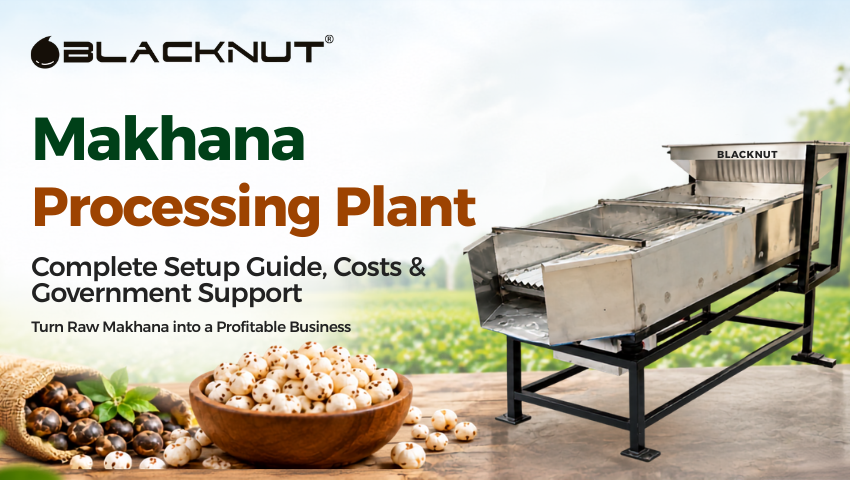
How to Set Up a Makhana Processing Plant in India: Machines, Costs & Subsidies
Makhana has gone from being a seasonal regional snack to one of India's fastest-growing health foods — and that shift has created a real opportunity for anyone thinking about setting up processing infrastructure. But here's the thing most people underestimate: the money in makhana isn't really in growing it. It's in processing it properly.
Raw seeds fetch a fraction of what cleaned, popped, graded, and packaged makhana sells for. Which is exactly why a well-planned makhana processing plant can turn a modest investment into a genuinely profitable business, whether you're a farmer looking to add value to your own harvest or an entrepreneur building a supply operation from scratch.
This guide walks through every makhana processing machine you'll actually need, realistic costs, government schemes worth applying for, and where to source both equipment and raw material.
Best Makhana Processing Plant Machinery Manufacturers in India
There's a big difference between someone who builds generic food processing equipment and someone who has spent years working specifically on makhana. Makhana behaves differently from other seeds — the popping process, the thermal shock, the fragility of the puffed kernel — and machines built without understanding that tend to give you poor yields and high breakage.
Blacknut Agrifood Machinery is one of the names that's built its reputation around this specialization. They've spent over two decades on makhana mechanization, working directly with farmers, cooperatives, and self-help groups in Bihar — which means their machines are designed around problems that show up in real production floors, not just testing labs.
When shortlisting any makhana processing plant manufacturer, ask them how many complete plants they've actually installed and whether you can speak to those clients. Genuine manufacturers won't hesitate.
Best Machinery Suppliers for Makhana Roasting and Grading in India
Roasting and grading are the two stages that most directly affect your selling price, so these machines deserve extra scrutiny.
A good makhana roasting machine should give you even heat distribution across every batch — usually through rotating drums or continuous-motion systems that keep seeds moving rather than sitting on a hot spot. Uneven roasting means burnt kernels mixed with under-roasted ones, and that directly eats into your margins through rejections.
Grading machines, meanwhile, sort popped makhana into size categories like Lava, Murra, and Thumri. This matters more than people realize, because each grade commands a noticeably different price in the market. A mixed, ungraded batch always sells for less than properly sorted output.
Look for suppliers who offer both as part of an integrated line rather than buying them separately from different vendors — mismatched capacities between machines create bottlenecks that are frustrating and expensive to fix later.
How to Start a Makhana Processing Plant with Low Investment
You genuinely don't need crores to get started. Plenty of successful units began small and expanded as cash flow improved. A practical low-investment approach looks something like this:
- Start with the core stages only — popping and basic grading. A makhana roasting machine and flavoring unit can come later once your volumes justify it.
- Go semi-automatic instead of fully automatic at first. The cost difference is significant and manual handling is manageable at lower volumes.
- Rent or use existing space rather than constructing a purpose-built facility on day one.
- Apply for subsidies before purchasing — this is the single biggest cost reducer available and most people skip it.
- Build buyer relationships early so you're not sitting on inventory once production starts.
Small units running 100–200 kg per day can be genuinely viable, and many SHGs and rural entrepreneurs have started at exactly this scale before growing.
Detailed Project Report for a Small-Scale Makhana Processing Unit
If you're planning to apply for a bank loan or government subsidy, you'll need a proper DPR (Detailed Project Report). Most applications get rejected or delayed simply because this document is incomplete. A solid DPR should cover:
- Project overview — what you're producing, at what capacity, and for which market
- Machinery list with quotations — itemized equipment from your chosen makhana processing machine supplier, with actual written quotes
- Land and building details — owned, leased, or rented, with supporting documents
- Raw material sourcing plan — where you'll buy seeds and at what expected rates
- Working capital requirement — salaries, electricity, packaging material, transport
- Financial projections — realistic revenue, cost, and break-even estimates over 3–5 years
- Marketing plan — who's actually going to buy your output
A tip worth following: ask your machinery manufacturer whether they can help with technical specifications for the DPR. Established suppliers usually have this documentation ready, which saves you considerable back-and-forth.
Top-Rated Makhana Processing Plant Equipment Suppliers
A complete plant isn't one machine — it's a connected chain, where each makhana processing machine handles a specific stage of a 7-step journey, from raw seed to packaged product:
- Harvesting – seeds are collected from the ponds where the makhana plant grows, marking the start of the entire process
- Cleaning & drying units – washing away mud and husk, then reducing moisture before the seeds move to the next stage
- Popping machines – the heart of the operation, applying controlled thermal shock that bursts the shell and puffs the kernel
- Sorting machines – removing defective, discolored, or unpopped seeds right after popping
- Grading machines – multi-tier sieves sorting the good kernels by size into categories like Lava, Murra, and Thumri
- Roasting & flavouring machines – applying final heat treatment along with masala, cheese, chocolate, or other coatings
- Packaging machines – vacuum or nitrogen-flushed packing to lock in freshness and shelf life
The better makhana processing plant in India suppliers offer all seven stages as one coordinated system rather than making you piece it together from different vendors. Blacknut, for instance, builds across this entire value chain — from popping and sorting to grading, roasting and flavouring, and complete processing plants — which means you can start with a few machines and expand within the same ecosystem as your production grows.
Cost Estimate for Setting Up an Automated Makhana Plant
Let's get into actual numbers, since this is what most people are here for. The makhana processing plant cost depends primarily on capacity and how much automation you want:
- Small-scale setup (basic popping + grading, semi-automatic) — roughly ₹8 to 10 lakh
- Mid-range unit (popping, grading, basic packing, plus a makhana roasting machine) — around ₹12 to 15 lakh
- Fully automatic plant (complete line including flavouring and vacuum packaging, export-grade) — ₹25 to 30 lakh and above
Beyond machinery, budget separately for:
- Building or shed modification (₹1–3 lakh depending on condition)
- Electrical connection and wiring for commercial load
- FSSAI licensing, Udyam registration, and GST registration
- Working capital for at least 3 months of raw material and salaries
One thing to confirm explicitly with your supplier: whether the quoted price includes installation, operator training, and GST. Food processing machinery attracts 18% GST, and that's a meaningful difference on a ₹20 lakh quote.
Government Schemes and Subsidies for Food Processing Units in India
This is where a lot of first-time entrepreneurs leave money on the table. There's substantial government support available right now, especially for makhana specifically.
PMFME Scheme (Pradhan Mantri Formalisation of Micro Food Processing Enterprises) — offers a credit-linked capital subsidy of 35% of eligible project cost, with a maximum ceiling of ₹10 lakh per unit. SHGs can also access seed capital of ₹40,000 per member for working capital and small tools, up to ₹4 lakh per SHG federation. Applications go through the official portal at pmfme.mofpi.gov.in.
ODOP advantage for Bihar — Makhana is the designated One District One Product for districts like Darbhanga and Madhubani, which means makhana units in these areas get prioritized for branding and marketing support on top of the core subsidy. Bihar has seen strong uptake here, with 51 makhana-based food processing units sanctioned in Darbhanga district alone.
National Makhana Board — Launched in Purnea, Bihar in September 2025 with a ₹476.03 crore Central Sector Scheme running through 2031, funding infrastructure for grading, popping, nitrogen-flushed packaging, and Common Facility Centres across 16 Bihar districts.
Credit guarantee support — CGTMSE provides collateral-free loan coverage for MSMEs up to ₹5 crore, which helps considerably if you don't have property to pledge.
A practical note: apply for subsidy approval before purchasing machinery, not after. Most schemes require prior sanction, and post-purchase claims often get rejected.
Where to Buy Makhana Processing Plant Machines Online
Buying machinery online has become fairly standard now, but it still pays to be careful. Established manufacturers list full specifications for every makhana processing machine on their websites, and most will send you a detailed brochure, quotation, or video walkthrough of the machine running before you commit.
Blacknut, for example, lets you enquire directly through their website or over WhatsApp, which is usually the fastest route to actual pricing rather than waiting on email chains. Whichever supplier you go with, get these confirmed in writing before transferring any money:
- Exact machine specifications and capacity
- Warranty terms and what's covered
- Installation and training — included or extra?
- Delivery timeline and transport responsibility
- Payment schedule and refund terms
And if you can manage it, a factory visit before purchase is worth the trip. Seeing the manufacturing setup in person tells you far more than any website.
Where to Buy Raw Makhana Seeds in Bulk for Processing
Your machinery is only half the equation — consistent raw material supply is what actually keeps a plant running profitably.
Bihar mandis remain the primary source, with Darbhanga, Madhubani, Purnia, and Katihar being the main trading hubs. Prices fluctuate seasonally, so buying during peak harvest (roughly August to October) usually gets you better rates.
Direct farmer procurement cuts out middlemen entirely and often gives you better quality control, though it requires building relationships over time and handling logistics yourself.
FPOs and cooperatives are increasingly good sourcing partners — they aggregate supply from multiple farmers, which means more consistent volumes and often better grading at source.
Online B2B platforms work for smaller trial orders, but for regular bulk requirements, direct relationships almost always work out cheaper and more reliable.
One thing worth doing: always check moisture content and seed size grading before finalizing a bulk purchase. Poor quality input will limit your popping yield no matter how good your machines are.
Profit Margins by Business Model
Before you invest in machinery, it helps to know where the actual money sits in the makhana business:
- Wholesale Trading – Margins typically stay in the 15–20% range. This model works on volume, not premium pricing — you're moving large quantities with lower per-unit returns, so consistency and repeat bulk orders matter more than branding.
- Retail Packaged – Margins climb to 30–40% once you package and sell under your own brand. Owning the packaging and pricing gives you far more control than selling loose or unbranded stock.
- Flavored Added – This is where the real upside is, with margins reaching 30–50%. Turning plain popped makhana into cheese, peri-peri, or masala variants using a proper roasting and flavouring machine commands genuinely premium consumer pricing — this is exactly the stage Blacknut's roasting and flavouring line is built for.
- Farming – For growers processing their own harvest, net profits range from ₹2 lakh to ₹3 lakh per acre, noticeably higher than traditional crops like paddy. You can check how to do makhana business via this How To Start Makhana Business: Investment, Margins & 4 Models.
The pattern here is pretty clear: the further you move from selling raw seeds toward selling a finished, flavored, branded product, the better your margins get — and that shift is entirely dependent on having the right processing equipment at each stage.
Why the Market Is Growing
- Healthy Snacking Trend – Consumers are actively replacing fried junk food with high-protein, low-calorie superfoods, and makhana fits that shift perfectly.
- Strong Global Demand – India produces the vast majority of the world's makhana, mostly out of Bihar, and international exports are scaling rapidly — a trend that's pushing more processors toward export-grade, hygienic machinery.
- Government Support – Initiatives like the National Makhana Board are backing this growth with subsidies and grants for processing units, which makes it a genuinely good time to set up or upgrade your equipment.
For a business riding this kind of growth curve, the machinery you choose becomes a long-term bet — one that needs to handle rising volume without breaking down or compromising on quality.
Choose Your Business Model — and the Right Blacknut Setup for It
Different business models need different machinery combinations. Here's how Blacknut's equipment lineup maps to each:
- D2C Packaged Brand – Source raw makhana, process it in-house or through contract manufacturers, and sell online via your website and quick-commerce apps. This model offers the highest margins (40–50%), and it typically needs a full setup — popping, grading, roasting & flavouring, and packaging — which is exactly what Blacknut's complete makhana processing plant covers end to end.
- Contract Manufacturing – Outsource the roasting and flavoring entirely and focus purely on marketing and sales. Even here, understanding your contract manufacturer's equipment (ideally Blacknut-grade, for consistency and hygiene standards) helps you maintain quality control over what goes out under your brand.
- Processing & Supply Chain – Buy raw seeds from farmers, then clean, grade, and supply bulk quantities to snack brands. This model leans heavily on Blacknut's cleaning and grading machines, since consistent grading is what determines the price you can command from B2B buyers.
- Export Business – Send bulk or branded processed makhana to international markets like the US, UAE, and Europe. Export buyers are strict about hygiene and consistency, which makes Blacknut's stainless steel, food-grade processing line a natural fit for meeting those standards without rework.
Whichever model you pick, the machinery decision isn't just about output — it's about which margin bracket you're able to compete in.
Final Word
Setting up a makhana processing plant in Bihar or anywhere else in India right now sits at a genuinely good intersection — strong domestic demand, growing export interest, and substantial government funding available for exactly this kind of unit.
The two decisions that matter most are your machinery supplier and your subsidy application. Get both right and the rest of the business becomes far more manageable. Take your time comparing manufacturers, ask uncomfortable questions about after-sales support, and don't skip the paperwork on government schemes — that's often the difference between a tight first year and a comfortable one.
Frequently Asked Questions
1. How Much Does It Cost to Set Up a Makhana Processing Plant?
The cost of setting up a makhana processing plant typically ranges from ₹5 lakh to ₹35 lakh, depending on the production capacity, automation level, and machinery configuration. Small-scale units require a lower investment, while fully automated processing plants designed for commercial production involve higher capital costs. Factors such as installation, utilities, packaging equipment, and labor requirements can also influence the overall investment.
2. Is the Makhana Business Profitable?
Yes, the makhana business can be highly profitable due to the growing demand for healthy snacks in India and international markets. Profit margins generally range from 10% to 50%, depending on factors such as processing efficiency, product quality, branding, distribution channels, and value-added offerings like flavored or packaged makhana.
3. How Is Makhana Processed?
Makhana processing involves transforming raw fox nut seeds into the puffed kernels commonly consumed as a snack. The process typically includes cleaning, grading, roasting, popping, polishing, and packaging. Traditionally, makhana processing was labor-intensive, but modern processing plants now use specialized machinery to improve efficiency, consistency, and product quality.
4. How Do I Start a Makhana Company?
Starting a makhana company begins with selecting a suitable business model, such as processing, packaging, wholesale trading, or branded retail sales. The next steps include sourcing quality raw makhana, setting up processing equipment, obtaining necessary licenses, developing a brand, and building a distribution network. A well-planned strategy can help entrepreneurs successfully enter this growing market.
5. How Can I Identify Fake or Low-Quality Makhana?
High-quality makhana is naturally white, lightweight, crunchy, and has a mild aroma. Low-quality or fake makhana may appear excessively bright, chalky, chemically polished, or have an unusual smell. Buyers should also look for uniform size, minimal impurities, and proper packaging when purchasing makhana products.
6. What Is the Most Expensive Type of Makhana in India?
7 Suta Makhana, which typically measures more than 21 mm in diameter, is considered one of the highest-value grades available in India. Due to its larger size, superior appearance, and premium quality, it commands higher prices compared to smaller grades and is often preferred for premium retail and export markets.
7. How Can I Sell Makhana?
There are multiple ways to sell makhana, including wholesale distribution, retail sales, online marketplaces, supermarkets, and direct-to-consumer channels. Many entrepreneurs increase profitability by offering flavored, roasted, or branded makhana products. Building a strong brand, attractive packaging, and an effective marketing strategy can help expand sales and customer reach.
8. What Is the Average Profit Margin in a Makhana Business?
The average profit margin in a makhana business typically ranges between 10% and 50%, depending on the business model and level of value addition. Businesses involved in processing, branding, and retail packaging often achieve higher margins than those selling raw or bulk makhana. Efficient operations and strong market positioning can significantly improve profitability.