
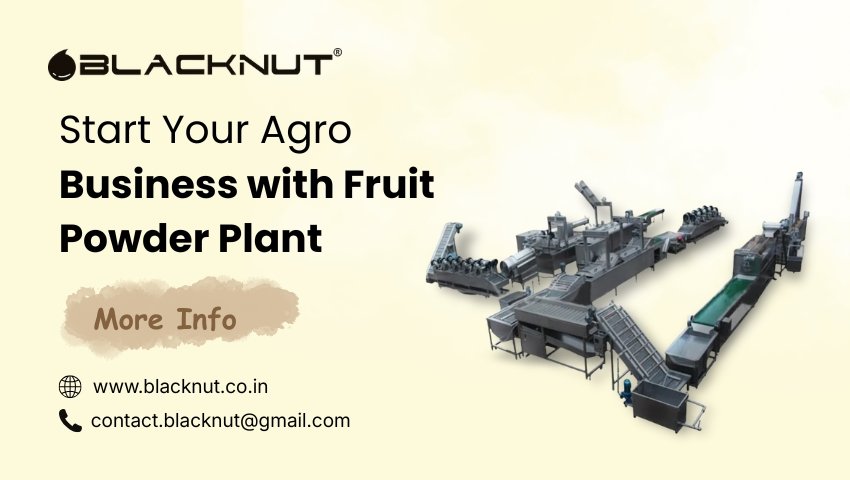
Fruit Powder Making Plant & Machine – Complete Industrial Setup
Global markets are seeing a sharp increase in demand for processed, shelf-stable food ingredients. Food manufacturers, exporters, nutraceutical brands, and institutional buyers are increasingly shifting toward fruit and vegetable powders due to their long shelf life, ease of transportation, and consistent quality. A professionally designed fruit powder making plant enables businesses to convert fresh, perishable produce into high-value powder products that can be sold year-round. For B2B buyers, this plant is not just machinery—it is a scalable production system that supports long-term profitability.
What Is a Fruit Powder Making Plant?
A fruit powder making plant is an integrated industrial setup used to process fresh fruits into dehydrated powder form. The plant follows a controlled, hygienic workflow that preserves natural flavor, color, and nutritional value while significantly extending shelf life. Such plants are widely used by food processors supplying raw materials to beverage companies, bakeries, dairy brands, supplement manufacturers, and export houses.
From a commercial standpoint, this setup allows businesses to move beyond raw produce trading and enter the value-added processing segment with better margins and stable demand.
What Makes Fruit & Vegetable Powder a Premium Product
Fruit and vegetable powders are considered premium ingredients in the food processing industry because they combine convenience, consistency, and quality. A thorough description of each major benefit is provided below:
Extended Shelf life without refrigeration
The extremely low moisture content of properly dehydrated fruit and vegetable powders inhibits the growth of microorganisms. This allows manufacturers to store the product for months without cold storage, reducing logistics and energy costs.
Easy storage and bulk transportation
Powdered products occupy less space and are lighter compared to fresh produce or purees. This makes bulk storage, handling, and long-distance transportation more efficient, especially for export-oriented businesses.
Consistent taste, color, and texture
Unlike fresh fruits and vegetables that vary by season and batch, powders offer standardized flavor, color, and particle size. For food and beverage producers who need consistent outcomes in each production cycle, this consistency is essential.
Year-round availability regardless of season
Seasonal fruits and vegetables can be processed during harvest peaks and stored in powder form. This ensures uninterrupted supply throughout the year, helping manufacturers maintain stable production schedules and pricing.
Compatibility with automated food production lines
Fruit and vegetable powders integrate seamlessly into automated mixing, blending, and packaging systems. In high-volume industrial operations, their free-flowing nature enhances efficiency and lowers processing errors.
When produced using advanced dehydration and grinding technology, fruit and vegetable powders retain a large portion of their natural nutrients, color pigments, and aroma compounds. This makes them highly suitable for clean-label, natural, and health-focused product formulations that modern consumers demand.
The Function of Equipment in Reliable Production
A processing unit's efficiency is mostly determined by the caliber of the equipment it uses. A modern fruit powder making machine integrates multiple stages, such as drying, grinding, and sieving, into a streamlined workflow. These machines are designed for uniform particle size, minimal product loss, and reduced manual intervention. Similarly, a robust vegetable powder making machine is engineered to handle fibrous and moisture-rich vegetables like spinach, onion, beetroot, and carrot. Industrial suppliers emphasize that automation not only enhances output consistency but also reduces operating costs over time.
Blacknut – Engineering Business-Ready Processing Solutions
Blacknut focuses on designing food processing systems that work in real business conditions. Instead of selling standalone equipment, Blacknut delivers requirement-based plant configurations.
Blacknut supports processors with:
- Capacity planning based on raw material and market demand
- Selection of the right fruit powder making plant setup
- Integration of fruit and vegetable powder machinery
- Installation guidance and ongoing technical support
This approach ensures efficiency, scalability, and better ROI.

How to Set Up a Fruit Powder Making Plant with Blacknut
1. Requirement Analysis & Capacity Planning
The installation of a fruit powder making plant with Blacknut begins with understanding your raw material type, daily output requirement, and target market. This step ensures the plant capacity and machinery configuration are aligned with your business scale and growth plans.
2. Plant Layout & Workflow Design
Blacknut designs a logical layout for the fruit powder plant to maintain smooth movement from washing and dehydration to grinding and packaging. Proper workflow planning reduces manual handling, improves hygiene, and increases overall operational efficiency.
3. Site Preparation & Infrastructure Setup
Before machine installation, Blacknut provides clear guidance on flooring, electrical load, water supply, and ventilation requirements. Correct site preparation ensures the fruit & vegetable powder-making plant runs safely, efficiently, and without avoidable operational delays.
4. Machine Installation & System Integration
All machines are positioned, aligned, and integrated according to the approved plant layout. Blacknut ensures that the fruit powder plant operates as a single, synchronized system, minimizing vibration, wear, and production interruptions.
5. Trial Run, Calibration & Operator Training
Once installed, the fruit powder making plant undergoes trial runs using actual raw material to set drying and grinding parameters. Blacknut also trains operators on daily operation, cleaning, and safety to maintain consistent powder quality.
6. Commissioning & Ongoing Technical Support
After final quality checks, the fruit powder making machine is commissioned for commercial production. Blacknut continues to provide technical support, maintenance guidance, and expansion assistance to ensure long-term reliability and ROI.
Products You Can Manufacture Using One Plant
With the right configuration, a single plant can produce multiple products, such as
- Mango powder
- Banana powder
- Apple powder
- Papaya powder
- Tomato powder
- Onion powder
- Beetroot powder
- Spinach powder
This versatility makes the powder making plant ideal for processors working with mixed raw materials.
Navigating Regulations
Setting up a fruit powder making plant requires strict compliance with food safety and processing regulations to operate legally and scale confidently. In India, manufacturers must obtain an FSSAI license and follow standards defined for processed fruit and vegetable products, including hygiene, quality, and labeling norms. Export-oriented units are additionally expected to comply with HACCP or ISO 22000 food safety management systems, which are widely recognized by global buyers. Proper packaging, nutritional labeling, and shelf-life declaration are mandatory under FSSAI regulations.
Small Setup, Big Returns
A contemporary fruit powder manufacturing facility serves as a growth engine for food companies in addition to being a processing facility. Manufacturers are able to consistently and confidently meet market demand thanks to the proper dehydration technology, sophisticated fruit powder making machine systems, and a reliable vegetable powder making machine. With its business-first engineering approach, Blacknut helps processors build scalable, compliant, and future-ready powder manufacturing plants designed for long-term success.
FAQs –
1. What is a fruit powder making plant?
A fruit powder making plant is an industrial setup used to convert fresh fruits into dehydrated powder through washing, drying, grinding, and packaging. These plants are widely used by food processors, exporters, and nutraceutical manufacturers to produce shelf-stable, high-value ingredients.
2. How does a fruit powder making plant work?
A fruit powder making plant works by first cleaning and slicing fruits, then dehydrating them using controlled drying technology. The dried material is ground using a fruit powder making machine, sieved for uniform size, and packed under hygienic conditions to prevent moisture absorption.
3. Is a fruit powder-making plant profitable for commercial use?
Yes, a fruit powder making plant is highly profitable because it reduces post-harvest losses and converts raw produce into value-added products. Long shelf life, export demand, and multi-industry applications make it a strong long-term investment for food processing businesses.
4. What is the difference between a fruit powder making machine and a vegetable powder making machine?
A fruit powder making machine is designed for softer, sugar-rich fruits, while a vegetable powder making machine handles fibrous and moisture-heavy vegetables like onion, spinach, and carrot. Both machines are often integrated into a single processing line for versatile production.
5. What are the advantages of using dehydrated vegetable powders?
Dehydrated vegetable powders offer a long shelf life without refrigeration, making storage and transportation easy and cost-effective. They provide consistent taste, color, and quality throughout the year, regardless of seasonal availability. These powders are easy to handle in bulk and compatible with automated food production, while retaining much of their natural nutrients and pigments when processed correctly.