
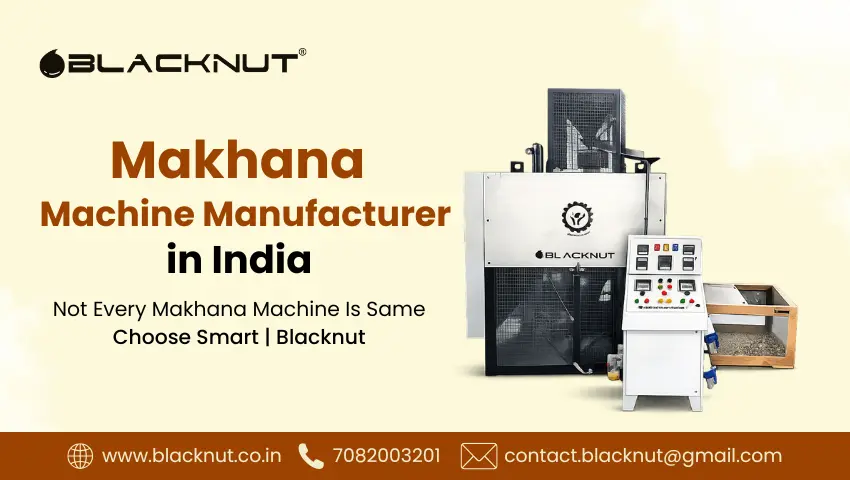
Makhana Machine Manufacturer in India: How to Choose the Right One (2026 Guide)
If you’re planning to start a makhana processing business in India, choosing the right makhana machine manufacturer in India matters more than anything else. Get this right and your unit runs smoothly, your product quality stays consistent, and your profits grow.
This 2026 guide covers essential makhana processing machines, realistic makhana machine price ranges, subsidy options, and how to evaluate manufacturers.
Here's what you'll find inside:
- Which makhana processing machines you actually need
- Real price ranges to expect in 2026
- A checklist of what to look for in a manufacturer
- Questions to ask before you spend a single rupee
- Why Blacknut is the trusted choice for makhana entrepreneurs across India
Let's get into it.
Who Is This Guide For?
Not everyone searching for a makhana machine manufacturer is at the same stage.
Some of you are planning your first unit. Some are replacing a machine that let you down. Some are scaling up an existing operation.
Find yourself in the list below, then keep reading.
You are in the right place if you are:
A first-time entrepreneur planning a makhana unit You have done your research on the business. Now you need to figure out which machines to buy, how much to spend, and who to trust. This guide gives you everything you need before you call a single manufacturer.
Currently processing manually and ready to upgrade You are sorting or roasting by hand right now. Output is limited. Quality varies. Labour costs are eating your margin. This guide helps you decide which machine to invest in first for maximum return.
Someone who got burned by a bad manufacturer You bought a machine that keeps breaking down. The manufacturer has gone silent. You are looking for a reliable partner this time. This guide gives you a checklist so it never happens again.
An investor evaluating the makhana processing business You are not committed yet. You want to understand real machinery costs before making a decision. This guide gives you honest numbers — not sales pitch figures.
An existing unit owner looking to scale Your current setup works but you need more capacity or better automation. This guide helps you evaluate your next machine investment.
This guide is not for you if:
You are looking for makhana recipes or home cooking tips
You are a farmer looking for cultivation or sourcing guidance
What Is a Makhana Processing Machine? (And Why You Need the Right One)
Before we talk about manufacturers, let's quickly understand what these machines do.
Makhana processing means turning raw lotus seeds, hard, dark, and inedible, into the white, crunchy, ready-to-eat product you see in stores.
This happens in stages. And each stage needs a different machine.
Buying the wrong machine for the wrong stage is one of the most common and expensive mistakes new entrepreneurs make.
Here's what each machine does:
- Makhana Popping Plant This machine handles the most important step, popping. It applies controlled heat to dried lotus seeds until they pop open, just like popcorn. Without a proper popping machine, your pop rate will be inconsistent and wastage will be high.
- Makhana Sorting Machine After popping, the batch contains good makhana mixed with unpopped seeds, shells, and dust. A sorting machine separates all of that automatically, saving hours of manual labour every single day.
- Makhana Grading Plant Makhana comes in different sizes, small, medium, large, and extra large. Buyers and retailers pay more for size-consistent product. A grading plant separates your batch by size automatically so you can price and package accordingly.
- Makhana Roasting and Flavouring Machine This is the machine behind every flavoured makhana pack you see in stores. It roasts plain makhana to the right temperature and coats it evenly with your chosen seasoning, whether that's peri-peri, cheese, or classic salt.
- Makhana Processing Plant Think of this as the complete solution. It combines all stages into one production line, from raw seed to finished packet. Best suited for medium to large scale operations.
Makhana Machine Price in India – What to Realistically Expect in 2026
This is the question everyone asks first. And it deserves an honest answer.
In 2026, most makhana machines in India are likely to fall somewhere between around ₹3–4 lakh for small or basic units and ₹25–30 lakh or more for high‑capacity, fully automatic plants, depending on capacity, level of automation, and customization.
A small‑scale unit starting out can usually begin with an investment of roughly ₹3–10 lakh in machinery, depending on the exact configuration and capacity.
The price ranges below are approximate 2026 market estimates to help you plan. Actual quotes will vary by capacity, level of automation, brand, and customization.
Here's a rough breakdown by machine type:
| Machine | Approx. Price Range (INR) | Typical Capacity (kg/hour) |
|---|---|---|
| Makhana Popping Plant | ₹3,00,000 – ₹23,00,000 (up to ₹30,00,000 for very large/fully automatic) | up to 50; 50–200; 200+ |
| Makhana Sorting Machine | ₹1,00,000 – ₹5,00,000 (higher for high‑speed/optical sorters) | up to 50; 50–200 |
| Makhana Grading Plant | ₹3,00,000 – ₹14,00,000 | up to 50; 50–200; 200+ |
| Makhana Roasting & Flavouring Machine | ₹5,00,000 – ₹25,00,000 (higher for integrated continuous lines) | up to 50; 50–200; 200+ |
| Makhana Processing Plant (Full Line) | ₹3,00,000 – ₹30,00,000+ (depends on automation & scope) | 50–200; 200+ |
Important note: Price alone should never be your deciding factor.
A cheap machine that breaks down every month will cost you far more in lost production, repairs, and missed orders than a slightly more expensive machine that runs reliably for years.
FSSAI guidelines require all food contact surfaces to be made from safe, non‑corrosive, non‑reactive, food‑grade materials; in practice, SS304 stainless steel is the standard grade used in compliant food processing machinery in India.
For a complete guide on starting your makhana business from scratch, read our full guide: How To Start Makhana Business
Can you get a subsidy on makhana machines?
Yes. Under the PMFME Scheme (Pradhan Mantri Formalisation of Micro Food Processing Enterprises), eligible micro food processing units can get up to 35% credit‑linked capital subsidy on their project cost, which includes machinery, subject to scheme guidelines and approvals.
This can significantly reduce your upfront investment. Ask your manufacturer if their machines qualify under this scheme.
How to Choose the Right Makhana Machine Manufacturer in India
Here is your complete checklist. Use this before talking to any manufacturer, including Blacknut.
- Do They Specialise in Makhana Machines?
This matters more than most people realise. A manufacturer who makes makhana machines alongside 50 other food machines has divided attention. A specialist who focuses on makhana understands the unique challenges, popping temperature control, seed size variation, moisture levels, and more. Always ask: "How long have you been making makhana machines specifically?" - Is the Build Quality Food Grade?
As mentioned above, FSSAI mandates SS304 food grade stainless steel for any surface that touches your product. Superior build quality with food-grade materials guarantees longevity and a hygienic production environment. Ask for the material specification sheet before purchasing. - What Is the Real Output Capacity?
Every manufacturer will give you a spec sheet with impressive numbers. But spec sheet numbers are measured under ideal lab conditions, not in real world production. Always ask: "What is the actual output per hour under normal conditions?" A machine rated at 100 kg/hour might realistically give you 70 to 80 kg/hour in daily operations. That difference matters for your production planning. - What Does After Sales Service Look Like?
This is where most cheap manufacturers fail completely. Ask these questions directly: How quickly can you send a technician if my machine breaks down? Are spare parts available locally or will they take weeks? Do you provide operator training after installation? Machines should come with installation and training services so your staff can operate them confidently and maximise output from day one. - What Is the Warranty?
Get the warranty terms in writing. Understand exactly what is covered and what is not. A genuine manufacturer stands behind their product with a clear warranty policy. - Can You See the Machine Before Buying?
Always ask for a live demo, either at the factory or via video call. Any manufacturer who refuses to show you the machine running live is a red flag.
Questions to Ask Any Makhana Machine Manufacturer Before You Buy
Print this list. Ask every manufacturer these questions:
- What is the actual output per hour under normal operating conditions?
- What material is used for food contact surfaces, is it SS304 food grade?
- What is the warranty period and exactly what does it cover?
- How long does installation take and who handles it?
- Do you provide operator training after installation?
- How quickly can spare parts be delivered if needed?
- How fast can a technician reach my unit in case of breakdown?
- What is the machine's power consumption per hour?
- How much space does the machine require?
- Is this machine eligible under the PMFME subsidy scheme?
- Can I visit your factory or see a live machine demo?
Why Blacknut Is the Right Choice for Your Makhana Business
Blacknut Agri Food Machinery Pvt. Ltd. is based in Ambala, Haryana, and we build machines specifically for the makhana industry.
Not generic food machines adapted for makhana. Machines built from the ground up for makhana processing.
Here is what makes Blacknut different:
- Makhana-specific expertise: every machine we build is designed around the specific requirements of makhana processing
- Food grade construction: all product contact surfaces meet FSSAI's SS304 standard
- Real capacity outputs: we give you honest numbers, not inflated spec sheet figures
- After sales support: our team is available after your machine is installed, not just before the sale
- Operator training: we make sure your team knows how to run the machine correctly from day one
- Spare parts availability: we stock parts so you're never stuck waiting weeks for a repair
Our machines for makhana entrepreneurs:
- Makhana Popping Plant: automates the most critical production step
- Makhana Sorting Machine: removes impurities and saves daily manual labour
- Makhana Grading Plant: size-based separation for premium packaging and pricing
- Makhana Roasting and Flavouring Machine: consistent flavour coating at commercial scale
- Makhana Processing Plant: complete end-to-end production line solution
Contact Blacknut today for a free consultation and honest price quote
Conclusion
Your makhana machine is not just a piece of equipment.
It is the foundation of your entire business. It determines your product quality. Your daily output. Your profit margin. And your ability to scale.
Choosing the right makhana machine manufacturer in India is the single most important decision you will make when setting up your unit.
Do your homework. Ask the hard questions. And invest in a manufacturer who will still be there six months after the sale, not just before it.
Ready to talk?
Contact Blacknut today, get a free consultation, honest price guidance, and find the right machine for your production scale.
FAQs - Makhana Machine Manufacturer in India
Which machine is used for makhana processing?
Multiple machines are used depending on the stage. A Makhana Popping Plant handles popping. A Makhana Sorting Machine cleans the batch. A Makhana Grading Plant separates by size. A Makhana Roasting and Flavouring Machine handles flavoured products. A Makhana Processing Plant combines all stages into one line.
How much does a makhana machine cost in India in 2026?
In 2026, small or basic makhana machines in India typically start around ₹3–4 lakh, while high‑capacity, fully automatic makhana processing plants can go up to ₹25–30 lakh or more, depending on capacity and features.
Is makhana machine available on government subsidy?
Yes. The PMFME Scheme offers up to 35% credit-linked subsidy on food processing machinery including makhana machines. Ask Blacknut to guide you through the application process.
What material should a makhana machine be made of?
FSSAI guidelines require food contact surfaces to be made of safe, food‑grade, non‑corrosive materials; SS304 stainless steel is widely used in India because it meets these requirements and is easy to clean.
Where can I buy a makhana machine in India?
Buy directly from a specialist manufacturer like Blacknut. Avoid generic machinery dealers or resellers who may not understand the specific requirements of makhana processing.
How do I set up a makhana processing unit?
Start with the right business model, secure premises, get your FSSAI and other licenses, then invest in the right machines. Read our complete guide on how to start a makhana business in India for the full step-by-step process.