
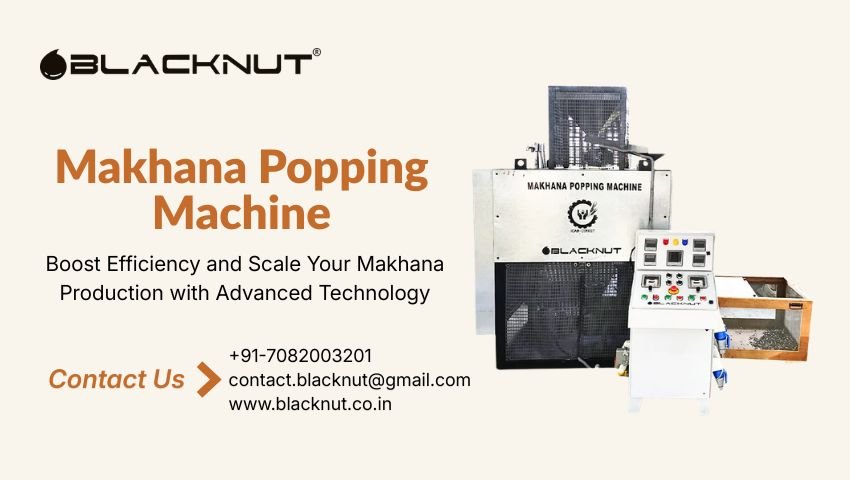
Makhana Popping Machine: How It Works, Price & How to Choose (2026 Guide)
You can have a good grading plant, a roasting machine, and proper packaging, but the popping step still matters a lot.
Popping is the most critical step in the entire makhana production process. It is where raw, hard, inedible lotus seeds become the white, light, crunchy makhana you see in stores.
Get this step right and everything downstream runs smoothly. Your pop rate is high. Your wastage is low. Your product quality is consistent.
If popping is not done well, you can end up with more wastage and lower returns.
This guide will help you choose the right makhana popping machine for your production scale, whether you are just starting out or upgrading an existing unit.
Here is what you will find inside:
What a makhana popping machine actually does
How the popping process works step by step
Real 2026 price ranges, honest numbers
How to choose the right capacity for your business
Key specs to check before buying
Why Blacknut's popping machine is built specifically for makhana
Let's get into it.
Who Is This Guide For?
Not everyone looking for a makhana popping machine is at the same stage.
Find yourself below, then keep reading.
You are in the right place if you are:
A first-time entrepreneur setting up a makhana processing unit You want to start processing raw makhana commercially. You need to understand what a popping machine does, what it costs, and which capacity is right for your budget and production target.
Currently popping makhana manually You or your team are using traditional iron pans and hand methods right now. Output is limited. Pop rates are inconsistent. Labour costs are high. You want to know if a machine is worth the investment, and which one to buy first.
Running a small scale unit and ready to upgrade Your current machine is giving low pop rates or inconsistent results. You want to upgrade to a better machine without overspending on capacity you cannot fill yet.
An investor evaluating makhana processing You want to understand the real cost of a popping machine before committing to the business. This guide gives you honest numbers to plan with.
This guide is not for you if:
You are looking for a makhana roasting or flavouring machine, read our Makhana Roasting and Flavouring Machine Guide instead
You need a complete production line, check our Makhana Processing Plant instead
What Is a Makhana Popping Machine?
Let's start with the basics.
Raw makhana seeds, also called lotus seeds or fox nut seeds, are hard and need proper processing before they can be eaten. They look nothing like the white fluffy makhana you see in packets.
To become edible makhana, the seeds need to be popped.
Popping is a bit like making popcorn, heat builds pressure inside the seed and makes it open up. The seed is exposed to intense, controlled heat. The moisture inside the seed turns to steam. Pressure builds up. And the seed pops open, expanding into the white, crunchy makhana you recognise.
A Makhana Popping Machine automates this process at commercial scale.
Instead of one person roasting seeds by hand in an iron pan, getting 5 to 10 kg per hour with inconsistent results, a commercial popping machine processes significantly higher volumes with consistent temperature control and much higher pop rates.
This is the machine that transforms a raw agricultural product into a commercial food product.
How Does a Makhana Popping Machine Work?
Here is the step by step process inside a commercial makhana popping machine:
Step 1: Feeding Dried raw makhana seeds are fed into the machine. The seeds must be properly dried before popping, excess moisture reduces pop rate significantly.
Step 2: Heating The machine heats the seeds to a precise temperature, typically between 200°C and 250°C. This heat helps create the pressure needed for the seed to pop.
Step 3: Popping At the right temperature the moisture inside the seed turns to steam rapidly. The seed pops open and expands, turning from a hard dark seed into white fluffy makhana. A well-set machine can give you a strong pop rate when the raw material is good and the settings are right.
Step 4: Separation After popping the batch contains popped makhana mixed with any unpopped seeds and debris. The machine separates these automatically.
Step 5: Discharge Popped makhana is discharged from the machine ready for the next stage, sorting, grading, and packaging.
A batch usually takes some time depending on the machine size, model, and moisture level of the seeds.
If you are planning to start a makhana processing business, read our complete guide: Makhana Business Guide
Makhana Popping Machine Price in India
This is what most people want to know first.
In India, makhana popping machine prices can vary quite a bit depending on capacity, build quality, and automation. For larger fully automatic plants the price goes significantly higher.
Here is a detailed breakdown:
What affects the price most:
Capacity: higher kg per hour = higher price
Automation level: fully automatic costs more than semi-automatic
Build material: SS304 food grade machines cost more than mild steel but are FSSAI compliant and last longer
Manufacturer: specialist makhana machine manufacturers vs generic food machinery makers
Important note on cheap machines:
A very basic machine may be cheaper, but it can be harder to get consistent results from it. That 15 to 25 percent difference in pop rate is pure wastage. On 100 kg of raw seed processed per day that adds up to significant losses every single month.
The right machine pays for itself through higher pop rates and lower wastage alone.
Can you get a subsidy?
Yes. Under the PMFME Scheme, eligible micro food processing businesses may be able to get credit-linked subsidy support. A makhana popping machine may be part of an eligible project, depending on the scheme rules. Machines can be used to begin the operation of a small-scale makhana processing unit beginning with approximately ₹3 to 10 lakhs of capacity. Contact Blacknut to understand how to apply for the subsidy.
How to Choose the Right Capacity
This is one of the most common questions first-time buyers ask.
Some people buy more capacity than they need, while others start too small and outgrow the machine too quickly.
Here is a simple guide to match capacity to your business stage:
Starting out: home or micro unit
Daily production target: 20 to 50 kg of finished makhana
Machine capacity needed: 10 to 20 kg per hour
Recommended investment: ₹1.5 to ₹4 lakh
Small to mid scale unit
Daily production target: 50 to 200 kg of finished makhana
Machine capacity needed: 20 to 50 kg per hour
Recommended investment: ₹4 to ₹8 lakh
Mid to large scale unit
Daily production target: 200 to 500 kg of finished makhana
Machine capacity needed: 50 to 100 kg per hour
Recommended investment: ₹8 to ₹15 lakh
Large scale processing plant
Daily production target: 500 kg and above
Machine capacity needed: 100 to 200+ kg per hour
Recommended investment: ₹15 lakh and above
The simple rule: Choose a machine that comfortably handles your current production target, with 20 to 30 percent headroom for growth. It is usually better to buy for your near-term plan, not just your long-term hope. Try to choose a machine that fits where your business is likely to be in the next year or so.
Key Specs to Check Before Buying
Do not buy any makhana popping machine without checking these:
1. Pop Rate Percentage This is one of the key things to look at. A good commercial popping machine should achieve 85 to 95 percent pop rate consistently.
Ask: "What is the average pop rate your machine achieves in real operating conditions?"
2. Temperature Control Precise temperature control is what determines pop rate consistency. Look for digital temperature controllers, not just manual dial settings.
Ask: "Does this machine have digital temperature control?"
3. Build Material Food contact surfaces should be made from safe, food-grade, non-corrosive materials. Mild steel may be cheaper, but food-grade materials are usually the better choice for processing equipment.
Ask: "What grade of stainless steel is used for food contact surfaces?"
4. Heating Source Makhana popping machines use either electric or LPG heating:
Electric: more precise temperature control, higher running cost
LPG: lower running cost, slightly less precise
Choose based on your fuel availability and daily production volume.
5. Actual vs Rated Capacity Spec sheets show maximum rated capacity. Actual output is often a little lower than the rated capacity, depending on how the machine is used.
Ask: "What is the actual output per hour under normal daily operating conditions?"
6. Ease of Cleaning Makhana processing creates dust and debris. A machine that is hard to clean will have hygiene problems over time. Ask to see how the machine is cleaned between batches.
7. Warranty and After Sales Support Get warranty terms in writing. Confirm spare parts availability and technician response time. This is where many cheap manufacturers fall short.
Manual Popping vs Machine Popping: The Real Comparison
Many entrepreneurs start with manual popping to save money. Here is the honest comparison:
The payback period depends on your production volume, labour cost, yield, and sales.
Looking for a trusted makhana machine manufacturer in India? Read our complete buyer's guide, Makhana Machine Manufacturer in India
Why Blacknut's Makhana Popping Plant
At Blacknut, we make machines with the makhana industry in mind. Our Makhana Popping Plant is designed specifically for makhana processing, with the practical needs of the business in mind.
Here is what makes it different:
Consistent pop rates of 85 to 95 percent: achieved in real operating conditions not just on a spec sheet
Precise digital temperature control: the same pop rate every batch every day
Food grade SS304 construction:built with food-grade construction for food processing use
Multiple capacity options: from small scale startups to large processing plants
Low wastage design: drum and discharge system minimises product loss
Easy to clean: designed for fast cleaning between batches
After sales support: we stay available after installation to help with support and training too
Operator training: we train your team to run the machine correctly from day one
Spare parts availability: we keep spare-part support in place so downtime stays low
Whether you are starting small or planning for higher output, we can help you look at the right machine for your scale and budget.
Contact Blacknut today for a free consultation and honest price quote
FAQs: Makhana Popping Machine
Q1. What is a makhana popping machine used for?
It converts raw dried lotus seeds into popped makhana; the white, crunchy product you see in stores. It applies controlled heat to cause the seed to pop open and expand, similar to how popcorn works. It is a core machine in a makhana processing unit.
Q2. How much does a makhana popping machine cost in India in 2026?
Prices range from ₹50,000 for basic manual-assisted machines to ₹30 lakh and above for large scale automated popping plants. For a commercial semi-automatic machine suitable for a small to mid scale unit, expect to invest ₹1.5 to ₹8 lakh depending on capacity. Contact Blacknut for an exact quote based on your production requirement.
Q3. What capacity makhana popping machine do I need?
Match capacity to your daily production target. Starting out, a 10 to 30 kg per hour machine is sufficient. Mid scale units need 30 to 100 kg per hour. Large plants need 100 kg per hour and above. Always buy with 20 to 30 percent headroom for growth.
Q4. What is a good pop rate for a makhana popping machine?
Pop rate depends on the raw material, moisture, temperature, and machine setup. Anything below 80 percent means significant wastage that directly impacts your profitability.
Q5. What material should a makhana popping machine be made of?
FSSAI requires food contact surfaces to be made of food-grade non-corrosive materials. Food-grade stainless steel is commonly used in food processing machines, and the exact material should be checked with the manufacturer. Always ask for the material specification before purchasing.
Q6. Is a makhana popping machine eligible for government subsidy?
Yes. The PMFME Scheme offers up to 35% credit-linked subsidy on food processing machinery including makhana popping machines. Contact Blacknut for guidance on the application process.
Q7. What is the difference between a semi-automatic and fully automatic makhana popping machine?
A semi-automatic machine requires an operator to load, monitor, and discharge batches manually. A fully automatic machine handles these steps automatically. Fully automatic machines cost more but reduce labour dependency and give more consistent results at higher volumes.
Q8. How long does one popping cycle take?
One complete cycle, loading, heating, popping, and discharge, takes approximately 20 to 40 minutes depending on machine capacity and model.
Q9. Can I start with a small popping machine and upgrade later?
Yes. Many entrepreneurs start with a small semi-automatic machine and upgrade as production grows. The key is to choose a manufacturer like Blacknut who offers multiple capacity options, so your upgrade path is straightforward.
Q10. How do I start a makhana processing business?
Start with understanding the business models available, get your FSSAI license, source raw makhana from reliable suppliers with consistent quality, and invest in the right machines starting with the popping plant. Read our complete guide; How To Start Makhana Business In India for the full step by step breakdown.
Conclusion
Every packet of makhana you ever sell starts with one step.
Popping.
Get this step right, with the right machine, the right capacity, and the right manufacturer behind you, and everything else in your production line runs smoother.
Get it wrong and you are fighting wastage, inconsistency, and machine downtime from day one.
Choose a makhana popping machine that is built specifically for makhana. With real temperature control. Food grade construction. And a manufacturer who supports you after the sale.
Ready to find the right popping machine for your production scale?
Contact Blacknut today, free consultation, honest capacity guidance, and a machine built specifically for makhana.